Introduction
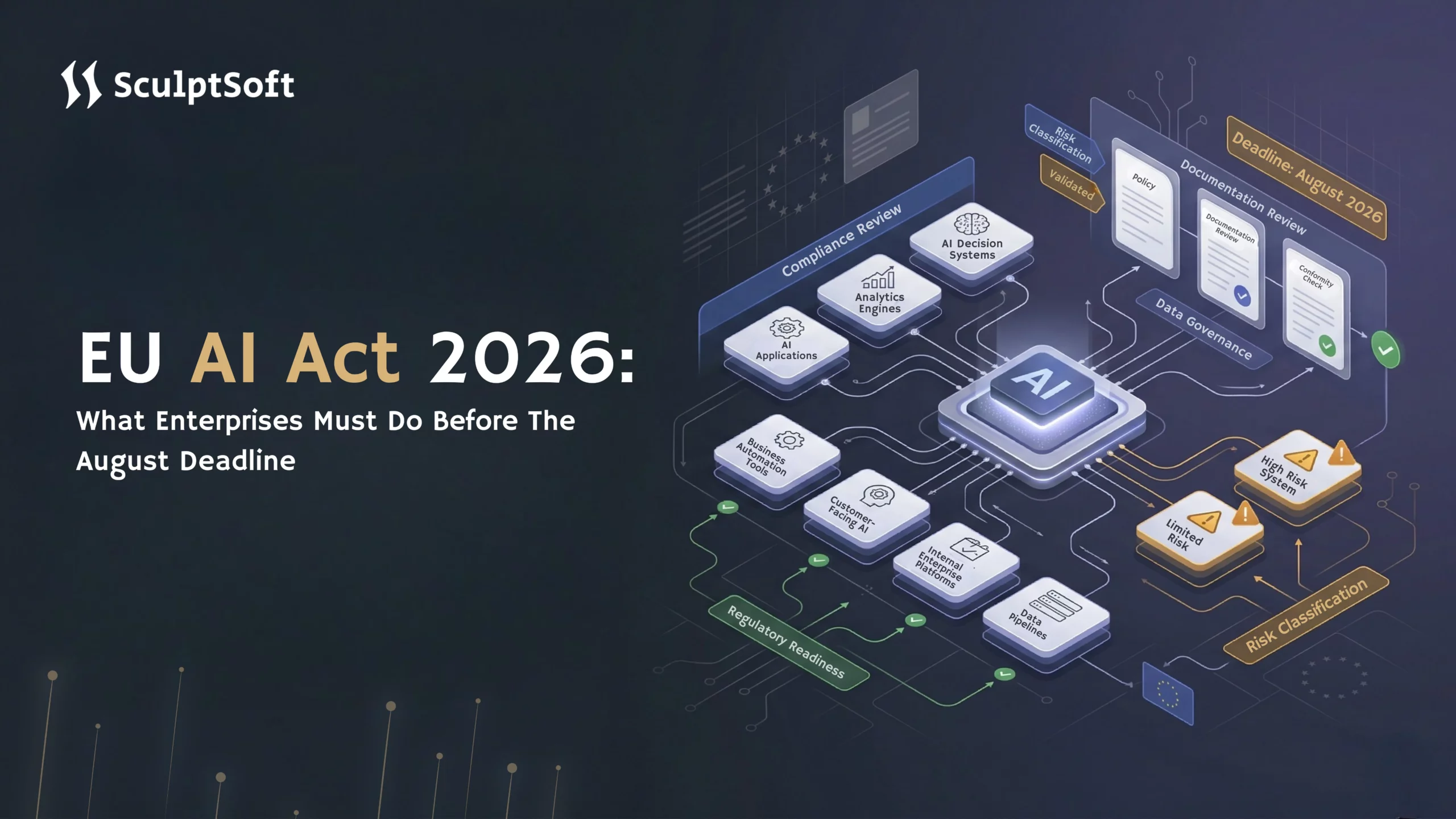
The EU AI Act is the world’s first comprehensive legal framework for artificial intelligence and its most critical compliance deadline hits on August 2, 2026.
From that date, any enterprise that develops, deploys, or uses high-risk AI systems within the European Union must be fully compliant. This includes AI used in hiring, credit scoring, fraud detection, healthcare diagnostics, and customer-facing decisions. Non-compliance means fines of up to €35 million or 7% of global annual revenue whichever is higher.
The regulation also has extraterritorial reach, similar to GDPR. Even if your company is headquartered outside the EU, if your AI systems affect EU residents, the EU AI Act applies to you.
The challenge is that most enterprises are significantly behind on EU AI Act compliance requirements. According to a 2026 readiness report, 83% of organizations have no formal AI system inventory, the very first step toward compliance.
Here is everything your enterprise needs to know:
- What is the EU AI Act and which organizations must comply
- How to classify AI systems under the EU AI Act risk framework
- EU AI Act requirements for high-risk AI and what August 2, 2026 means for your business
- How to comply with the EU AI Act – a 6-step enterprise compliance checklist
- EU AI Act fines and penalties for non-compliance and which industries are most at risk
What Is the EU AI Act?
The EU AI Act (officially Regulation EU 2024/1689) is the world’s first comprehensive law governing the development, deployment, and use of artificial intelligence. Adopted by the European Parliament in May 2024 and entered into force in August 2024, it sets legally binding rules for AI systems across all industries and sectors.
The goal is straightforward, ensure that AI systems used in the EU are safe, transparent, and respect fundamental human rights.
Who does the EU AI Act apply to?
The EU AI Act applies to:
- Providers: Companies that develop or build AI systems
- Deployers: Businesses that use AI systems in their operations
- Importers and Distributors: Organizations that bring AI products into the EU market
- Product Manufacturers: Companies embedding AI into physical products
It applies regardless of company size or where the organization is headquartered. If your AI system is used by or affects people in the EU, you must comply.
How is the EU AI Act structured?
The regulation follows a risk-based approach. Not all AI systems carry the same compliance burden. Obligations are determined by the level of risk an AI system poses from prohibited practices at the top to minimal-risk tools at the bottom.
This means businesses can continue building and using AI freely as long as it is safe, transparent, and does not harm people. The stricter the risk, the stricter the rules.
When did the EU AI Act come into force?
The EU AI Act follows a phased implementation timeline:
- February 2025: Prohibited AI practices became enforceable
- August 2025: Rules for General Purpose AI (GPAI) models activated
- August 2, 2026: Full compliance required for high-risk AI systems
The August 2, 2026 Deadline Explained
August 2, 2026 is the most critical date in the EU AI Act compliance timeline. From this date, full compliance requirements for high-risk AI systems become legally enforceable across all 27 EU member states.
This is not a soft launch. It is active enforcement.
Key Compliance Requirements Active from August 2, 2026
From this date, enterprises must have the following fully in place:
- AI risk management systems documented and operational
- Technical documentation completed for every high-risk AI system
- Data governance controls covering training data quality and bias
- Human oversight mechanisms for AI-driven decisions
- Transparency disclosures for AI-generated interactions and content
- EU database registration completed for applicable high-risk systems
- Conformity assessments signed off and audit-ready
Regardless of any ongoing regulatory discussions at the EU level, August 2, 2026 remains the confirmed enforcement date enterprises must plan around.
Which AI Systems Fall Under the August 2026 Deadline
The deadline applies to high-risk AI systems used in hiring, credit decisions, healthcare, education, law enforcement, critical infrastructure, and border control.
Not every AI system in your organization falls under this deadline. But if even one does, full compliance obligations apply to that system from August 2, 2026.
EU AI Act Risk Categories: How Is Your AI Classified?
One of the most common questions enterprises ask is does the EU AI Act apply to my AI system?
The answer depends entirely on how your AI is classified. The EU AI Act uses a four-tier risk classification system. Your compliance obligations, documentation requirements, and deadlines are all determined by which tier your AI falls into.
Here is how each category works.
Tier 1 Prohibited AI Practices
These AI systems are completely banned across the EU. No exceptions, no compliance pathway. Enforcement began on February 2, 2025.
Banned AI systems include:
- AI that manipulates human behavior without the person’s awareness
- Social scoring systems by governments or private companies
- Real-time biometric surveillance in public spaces
- AI targeting people based on age, disability, or financial vulnerability
- Emotion recognition tools in workplaces and schools
- Mass facial recognition through untargeted image scraping
If your organization runs any of these systems, the only required action is immediate shutdown.
Tier 2 High-Risk AI Systems
This is the most regulated category under the EU AI Act. High-risk AI systems must meet full compliance requirements by August 2, 2026.
These are AI systems used in areas that directly impact people’s rights, safety, and access to opportunities:
- Hiring and recruitment: CV screening, candidate ranking, interview scoring
- Credit and lending: Loan approvals, creditworthiness assessments
- Healthcare: AI-assisted diagnostics, treatment recommendations
- Education: Student assessment, admissions, performance tracking
- Law enforcement: Crime prediction, risk profiling tools
- Critical infrastructure: Energy grids, water systems, transport networks
- Border control: Identity verification, migration risk tools
- Essential services: Insurance decisions, benefits eligibility
Enterprises operating any of these systems must be fully compliant before the August 2026 EU AI Act deadline.
Tier 3 Limited Risk AI
Limited risk AI systems including chatbots, AI content generators, and deepfake tools are not banned but must meet EU AI Act transparency requirements.
This means:
- Users must be told they are interacting with an AI system
- AI-generated content must be clearly labeled
- Deepfakes must carry visible identification
Tier 4 Minimal Risk AI
The majority of everyday AI tools fall here – spam filters, product recommendation engines, CRM automation, inventory management. These carry no specific EU AI Act obligations.
However, businesses are encouraged to follow voluntary codes of conduct to stay ahead of future regulatory changes.
6 Steps Enterprises Must Take Before August 2026
Knowing the EU AI Act exists is not enough. The real challenge is knowing exactly what your enterprise must do before the August 2, 2026 enforcement deadline.
Here are the six steps every enterprise must complete to achieve EU AI Act compliance.
Step 1: Build a Complete AI System Inventory
You cannot comply with regulations for AI systems you do not know exist.
Start by mapping every AI system across your entire organization including:
- Internally built AI models and tools
- Third-party AI software and SaaS platforms with AI features
- AI embedded in vendor products and integrations
- Shadow AI tools employees use without formal approval
Without a complete inventory, every other compliance step is impossible.
Step 2: Classify Risk Levels Across All AI Systems
Once you know what AI systems you have, classify each one using the EU AI Act risk framework – prohibited, high-risk, limited risk, or minimal risk.
This step determines:
- Which systems require immediate shutdown
- Which systems need full compliance by August 2026
- Which systems only need transparency disclosures
- Which systems carry no specific obligations
Document your classification rationale for every system. Regulators will expect evidence of a structured, deliberate classification process not guesswork.
Step 3: Prepare Technical and Transparency Documentation
For every high-risk AI system, the EU AI Act requires comprehensive technical documentation covering:
- System architecture and intended purpose
- Training data sources, quality controls, and bias testing
- Performance metrics, accuracy benchmarks, and testing results
- Known limitations and foreseeable risks
- Human oversight procedures and intervention mechanisms
This documentation must be maintained, kept current, and made available to regulatory authorities on request. Starting this process early is critical, it is one of the most time-consuming compliance requirements.
Step 4: Implement an AI Risk Management System
The EU AI Act requires enterprises to operate a continuous AI risk management system, not a one-time assessment.
This means:
- Identifying and evaluating risks throughout the entire AI lifecycle
- Monitoring AI system performance and behavior in production
- Detecting and responding to model drift, bias, and unexpected outputs
- Maintaining logs and audit trails for regulatory review
- Updating risk assessments as systems evolve or are modified
Risk management must be an ongoing operational process, not a checkbox completed at deployment.
Step 5: Establish an AI Governance Framework
EU AI Act compliance requires clear organizational ownership of AI oversight. Enterprises must establish a formal AI governance framework that includes:
- A designated AI compliance officer or internal AI governance team
- Cross-functional involvement from legal, IT, data, and business units
- Board-level visibility and executive sponsorship
- Internal policies for AI development, procurement, and deployment
- A process for reviewing and approving new AI systems before launch
Enterprises without governance structures in place face the highest regulatory exposure because even technically compliant AI systems can fail audits if no one is formally accountable for them.
Step 6: Review and Update AI Vendor Contracts
Many enterprises deploy AI through third-party vendors and SaaS platforms which means compliance obligations extend across your entire supply chain.
Before August 2026, review all AI-related vendor contracts to confirm:
- Vendors can provide required technical documentation for their AI systems
- Contracts clearly define who is responsible, provider or deployer for compliance
- Vendors meet EU AI Act requirements for high-risk AI components
- Agreements include provisions for ongoing monitoring, updates, and incident reporting
A vendor’s non-compliance becomes your compliance risk. Due diligence on AI suppliers is now a legal necessity, not just a procurement best practice.
EU AI Act Penalties: Fines for Non-Compliance
The EU AI Act is not a guideline, it is enforceable law. And the fines for getting it wrong are significant, surpassing even GDPR penalties in the most serious cases.
Here is exactly what enterprises risk if they miss the August 2, 2026 compliance deadline.
EU AI Act Fine Structure
The EU AI Act applies fines in three levels based on the type of violation:
| Violation Type | Maximum Fine |
|---|---|
| Using banned AI practices | €35 million or 7% of global revenue |
| High-risk AI non-compliance | €15 million or 3% of global revenue |
| Providing false information to regulators | €7.5 million or 1% of global revenue |
The higher figure always applies whichever is greater between the fixed amount and the percentage of revenue.
Other Consequences of Non-Compliance
Financial penalties are not the only risk. Enterprises found non-compliant may also face:
- AI systems pulled from the EU market: Regulators can force you to stop using non-compliant AI immediately
- Operational disruption: Enforcement actions can halt business-critical AI systems
- Brand and reputational damage: Public penalties affect customer and investor trust
- Double exposure with GDPR: AI systems handling personal data can trigger both EU AI Act and GDPR fines simultaneously
Is Compliance Worth the Investment?
Building an EU AI Act compliance program for high-risk AI systems costs large enterprises between $8 million and $15 million on average.
That sounds significant. But compare it to a single Tier 1 fine – for a company with €500 million in annual revenue, that fine alone could reach €35 million.
Early compliance is not just the right thing to do. It is the smarter financial decision.
Which Industries Must Comply with the EU AI Act?
The EU AI Act applies to all industries. But enterprises in certain sectors face the highest compliance pressure because they already use AI to make decisions that directly impact people’s lives, rights, and access to services.
If your business operates in any of these industries, EU AI Act compliance is a business priority, not just a legal one.
1. Healthcare
AI in healthcare carries the highest risk of harm which means the highest level of regulation.
EU AI Act high-risk AI systems in healthcare include:
- Medical diagnostics and imaging analysis
- Treatment recommendation tools
- Patient risk scoring and clinical decision support
Healthcare enterprises must meet full EU AI Act compliance requirements including technical documentation, human oversight, and risk management before the August 2, 2026 deadline.
2. Financial Services
Financial institutions are among the most directly impacted by the EU AI Act.
AI systems used in credit scoring, loan approvals, fraud detection, and insurance eligibility are classified as high-risk. Banks and lenders also face dual obligations both EU AI Act and GDPR apply simultaneously to AI systems handling personal financial data.
3. Retail and E-Commerce
Retailers using AI for product recommendations and customer personalization face transparency obligations. Those using AI for employee management, workforce decisions, or customer credit assessments move into high-risk territory requiring full EU AI Act compliance.
4. Manufacturing
AI systems managing industrial safety, critical infrastructure, and supply chain operations are classified as high-risk. Manufacturers embedding AI directly into physical products must meet both EU AI Act requirements and existing product safety regulations.
5. Hospitality and Travel
Hospitality businesses using AI for staff recruitment, automated customer service, and access decisions must classify and document these systems under the EU AI Act. AI-powered hiring tools in particular fall under high-risk AI classification.
6. Human Resources - Every Industry
This is the most common EU AI Act compliance blind spot across all sectors.
Any enterprise in any industry using AI for hiring, CV screening, candidate ranking, employee monitoring, or performance evaluation is operating a high-risk AI system. Full compliance is required before August 2, 2026 regardless of company size or location.
Conclusion
The EU AI Act marks a fundamental shift in how enterprises build and use artificial intelligence. Compliance is no longer optional, it is a legal requirement with real financial consequences.
The steps are clear. Start with a complete AI system inventory, classify your risk levels, build your documentation, and put an AI governance framework in place before the August 2, 2026 deadline. Enterprises that act now will not only avoid penalties, they will build AI systems that are more trustworthy, more reliable, and more competitive in the long run.
EU AI Act compliance is also an opportunity. Organizations that get this right early will be better positioned to deploy AI faster, win enterprise contracts that require compliance proof, and build lasting trust with customers and regulators alike.
At SculptSoft, AI security, transparency, and responsible development are built into how we approach every AI solution. As a custom AI software development company, we design and build AI systems with governance, risk management, and compliance readiness as core principles, not afterthoughts.
Frequently Asked Questions
What is the EU AI Act?
The EU AI Act is the world’s first comprehensive law that regulates how artificial intelligence is developed and used. It applies to all organizations inside and outside the EU that build, deploy, or use AI systems affecting people in the European Union. It follows a risk-based approach, meaning your compliance obligations depend on how much risk your AI system poses.
Who needs to comply with the EU AI Act?
Any business that develops, deploys, imports, or distributes AI systems within the EU must comply. This includes AI providers, companies that use AI in their operations, and vendors supplying AI-powered products. Company size and location do not matter if your AI affects EU residents, you are in scope.
What is a high-risk AI system under the EU AI Act?
A high-risk AI system is one used in areas that directly impact people’s safety, rights, or access to opportunities. This includes AI used in hiring, credit scoring, healthcare, education, law enforcement, and critical infrastructure. These systems must meet the strictest compliance requirements under the EU AI Act before the August 2, 2026 deadline.
What are the EU AI Act fines for non-compliance?
Fines depend on the type of violation. Using banned AI practices can result in fines up to €35 million or 7% of global annual revenue. Failing to comply with high-risk AI requirements carries fines up to €15 million or 3% of global revenue. The higher figure between the fixed amount and the revenue percentage always applies.
How do I start complying with the EU AI Act?
Start by building a complete inventory of every AI system your organization uses or deploys. Then classify each system by risk level using the EU AI Act framework. From there, focus on documentation, risk management, and governance for any high-risk AI systems. The earlier you start, the more time you have to close compliance gaps before enforcement begins.