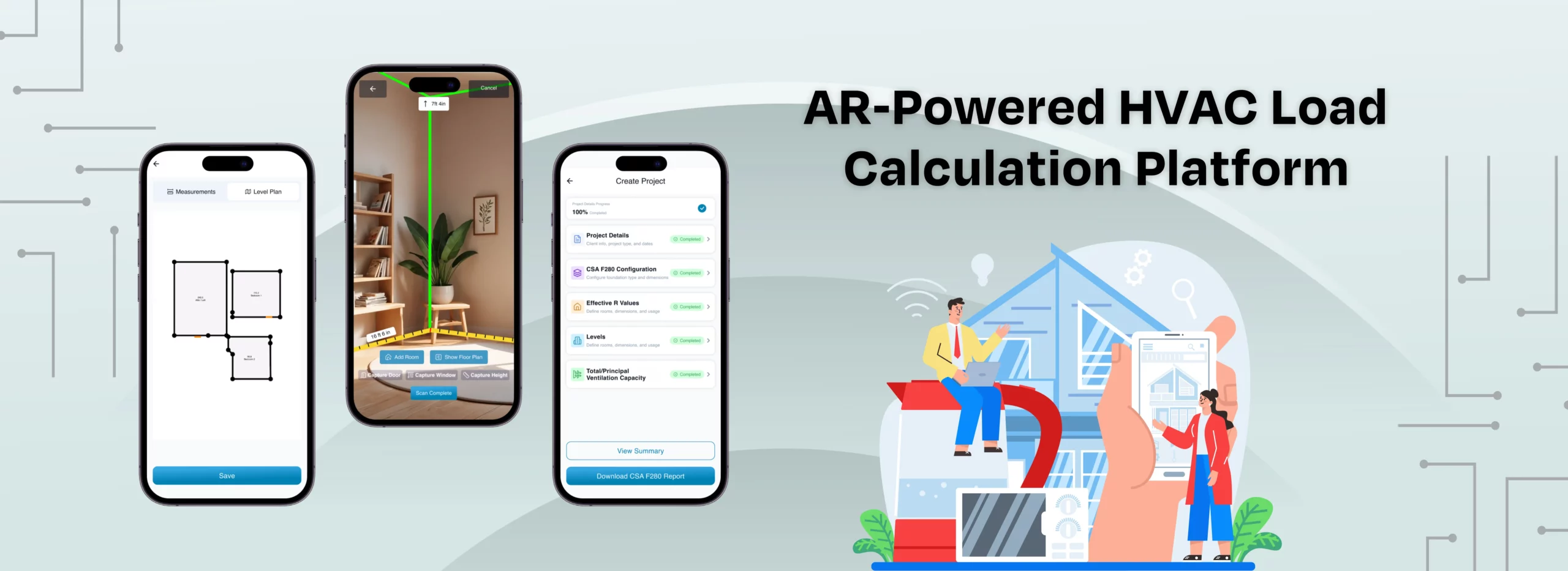
AR-Powered HVAC Load Calculation Platform
About Client
Industry
Contech
Location
Canada
Project Overview
Our client is a growing construction technology company serving HVAC contractors, mechanical engineers, energy auditors, and home builders across Ontario, British Columbia, and other Canadian provinces. Their professionals are responsible for producing code-compliant residential heat load calculations, which is a regulatory requirement before any new or retrofit HVAC system can be properly sized and installed. With a growing volume of residential projects and increasing scrutiny from inspectors and building authorities, the client needed a way to bring consistency, speed, and accuracy to a process that had relied on manual methods for decades. Field teams were spending significant time on-site measurements and off-site data processing, with no unified system to manage project data, calculations, or compliance documentation.
To eliminate these operational challenges, we developed AR-Powered HVAC Load Calculation Platform, a cross-platform mobile application for iOS and Android that digitizes the entire building assessment and HVAC calculation workflow, from room measurement to final report, directly from a field technician’s phone or tablet. The platform was designed to support multi-level residential structures by providing hierarchical component tracking for walls, windows, and doors, making it easier to identify and manage building elements throughout the project lifecycle.
By combining AR-powered room scanning, automated CSA F280 calculations, jurisdiction-aware code compliance, and one-tap report generation into a single mobile-first platform, the solution eliminated every manual step between arriving on site and delivering a final compliance report to the client.
Traditional Process
Before this, HVAC contractors and engineers followed a largely manual assessment process that was time-consuming, error-prone, and difficult to scale across growing project volumes. Every stage of the workflow from site measurement to final reporting depended on physical tools, spreadsheets, and manual documentation. Which includes:
01
Manual Site Measurements
Field teams visited properties with measuring tapes and paper forms. Room dimensions, windows, doors, and wall measurements were captured entirely by hand, along with wall directions and exposure details, leaving significant room for human error and inconsistency.
02
Spreadsheet-Based Calculation Workflow
After site visits, measurements were manually transferred into spreadsheets where CSA F280 heat load calculations were performed by hand. Building code references and R-values had to be looked up individually from PDF documents and physical code books, making the process slow and tedious.
03
Manual Report Preparation
Reports were created from scratch for every project. Any change to a measurement required recalculations and full report updates, turning even minor revisions into time-consuming tasks. There was no standardized format, and report quality varied across team members.
04
Disorganized Project Data Management
Project data was scattered across personal folders, spreadsheets, and email threads with no structured system to organize or track information across multiple properties. Retrieving past project data or maintaining consistency across ongoing projects was a constant challenge.
05
No Support for Multi-Level Property Management
Managing assessments for multi-level residential structures using traditional methods was particularly difficult. Tracking individual components such as walls, windows, and doors across multiple floors without a structured system led to confusion, missed elements, and inaccurate final calculations.
06
Limited Flexibility for Field Teams
Field teams had no digital tools to support their on-site work. Everything depended on physical forms and manual recording, leaving no room for flexibility or efficiency improvements in the field, regardless of the size or complexity of the project.
Challenges Faced
The client’s reliance on manual processes created compounding operational challenges as their project volumes grew. What once worked for a smaller workload became increasingly unsustainable, affecting field productivity, calculation accuracy, compliance reliability, and the overall speed of project delivery.
Below are the key challenges the client faced using their traditional methods:
01
Excessive Time Spent on Project Assessments
Each property assessment required significant manual effort both on site and in the office. Between physical measurements, spreadsheet transfers, code lookups, and report preparation, a single project could consume several hours of work that could otherwise be directed toward serving more clients.
02
High Risk of Human Error Across the Workflow
With every step of the process handled manually, the risk of errors was constant. Incorrect measurements, miscalculated heat load values, and inconsistent R-value inputs resulted in unreliable reports that could fail compliance checks or require costly rework.
03
Duplicate Data Entry Slowing Project Completion
Measurements captured on site had to be re-entered manually into spreadsheets and then again into report templates. This repetitive data entry not only consumed time but also introduced additional opportunities for mistakes at every transfer point.
04
Inconsistent Calculations Across Reports
Without a standardized calculation engine, results varied depending on who performed the calculations and which reference materials they used. This inconsistency made it difficult to maintain quality standards across projects and created complications during inspector reviews.
05
Time-Consuming Building Code Lookups and Compliance Validation
Contractors had to manually cross-reference building codes for each jurisdiction, looking up assembly specifications from physical code books or PDF documents. This process was slow, prone to oversight, and highly dependent on individual knowledge of the applicable codes.
06
Repetitive and Inefficient Report Formatting
Preparing a compliant HVAC report involved formatting data, organizing room-by-room calculations, and structuring documentation from scratch for every project. This repetitive work added hours to each engagement and offered no value beyond presentation.
07
Difficulty Managing Multi-Level Residential Properties
Tracking and organizing building components across multiple floors using spreadsheets and paper forms was cumbersome and error-prone. There was no structured way to reference individual walls, windows, or doors within a specific room on a specific level, making complex properties particularly difficult to manage.
08
No Flexible Workflow for Varied Device Capabilities
Field teams worked with a range of devices, and not all of them supported advanced technologies. The traditional setup offered no digital workflow at all, meaning the entire process depended on manual methods regardless of what tools or devices a technician had available on site.
Our Solutions - AR-Powered HVAC Load Calculation Platform
Key elements of our solution included the following:
01
AR-Powered and Manual Room Measurement
On supported iOS and Android devices, contractors use LiDAR and ARCore technology to scan each room as they walk through it. The application automatically captures wall dimensions, room geometry, and directional orientation in real time. For devices without AR capability, we built a manual drawing mode with snap-to-grid tools, scale calibration, and blueprint image tracing, ensuring every field team can use the platform regardless of their devices.
02
Hierarchical Building Structure and Component Tracking
The platform organizes every element of a multi-level residential building into a structured hierarchy covering levels, rooms, walls, windows, and doors, each assigned an automatically generated reference ID. This intelligent numbering system makes it straightforward to locate, update, or review any individual component throughout the project and ensures the final report reflects an accurate and complete picture of the building. The platform also supports multi-level project and component management, making large and complex residential properties straightforward to handle, with every building element remaining traceable, editable, and accurately reflected in the final compliance documentation.
03
Automated CSA F280 Heat Load Calculations
Once measurements are captured, the platform’s calculation engine automatically processes heat loss and heat gain values across walls, ceilings, slabs, rim joists, windows, doors, and ventilation components. Exposed and unexposed assemblies are handled separately, and effective R-values are computed automatically without requiring any spreadsheet input from the contractor.
04
Jurisdiction-Aware Building Code Compliance
The application detects the project’s jurisdiction using postal code data and automatically loads the correct code-compliant assemblies, whether the project falls under the Ontario Building Code, British Columbia Building Code, or National Building Code. Contractors no longer need to reference physical code books or manually cross-check assembly specifications.
05
One-Tap Professional Report Generation
With a single action, contractors generate a complete, structured HVAC report containing project information, room-by-room calculations, ventilation summaries, R-value documentation, floor plan layouts, and air leakage data. Reports can be shared directly from the device with clients, inspectors, or project stakeholders, eliminating the manual formatting stage entirely.
06
Flexible Workflow for All Device Types
By supporting both AR-assisted scanning and manual floor plan drawing with snap-to-grid tools and blueprint tracing, the platform accommodates every field scenario and device capability, giving all team members access to a consistent and efficient digital workflow. Through this solution, we empowered HVAC contractors and engineers to leave behind paper forms and spreadsheets entirely, replacing a fragmented, manual workflow with a fully guided, mobile-first assessment experience built for speed, accuracy, and compliance.
07
In-App Purchase for Report Download
The platform includes built-in in-app purchase support, allowing contractors to unlock and download final HVAC reports directly from their device. This provides a seamless and self-serve way to access, save, and share compliance documentation without any manual steps or external tools.
Outcome
By implementing the AR-Powered HVAC Load Calculation Platform, the client transformed their entire HVAC assessment process from a manual, time-intensive operation into a streamlined, digitally guided workflow. The platform delivered significant improvements across field productivity, calculation accuracy, compliance reliability, and overall project turnaround times.
Features
AR Room Scanning
Manual Floor Plan Drawing
Blueprint Image Upload
Multi-level Structure Support
Hierarchical Component Tracking
Automated CSA F280 Calculations
Effective R-value Engine
Interactive Floor Plan Viewer
One-tap Report Generation
Exportable HVAC Reports
Compass-based Wall Orientation
Ventilation Sizing
Authentication (Email / Google / Apple)
Company Profile & Signature
In-app Purchase Support
Technologies Used

Mobile Development
- Flutter
- Dart SDK
- GetX

Backend & Cloud Infrastructure
- AWS Amplify
- AWS Cognito
- AWS Lambda
- REST APIs

Email Authentication
- Google Sign-In
- Apple Sign-In

Platform Support
- Android
- iOS
- Cross-Platform Mobile Architecture

Native AR Technologies
- Android
- Kotlin
- ARCore
- iOS
- Swift
- ARKit

Maps & Utilities
- Google Maps Integration
- Authentication & Security

Mobile Commerce
- Android In-App Purchase
- iOS In-App Purchase