Agentic AI Sales & Order Automation Platform
About Client
Industry
Retail & Manufacturing
Location
Kenya
Project Overview
The client sought to modernize and streamline their sales and order processing operations by reducing manual dependency across customer inquiries, product discovery, quotation generation, and payment. With increasing inbound requests across multiple channels, such as WhatsApp, Instagram, and Facebook, the existing sales workflow faced delays, inconsistent responses, and limited visibility into customer interactions, often resulting in missed opportunities and extended sales cycles.
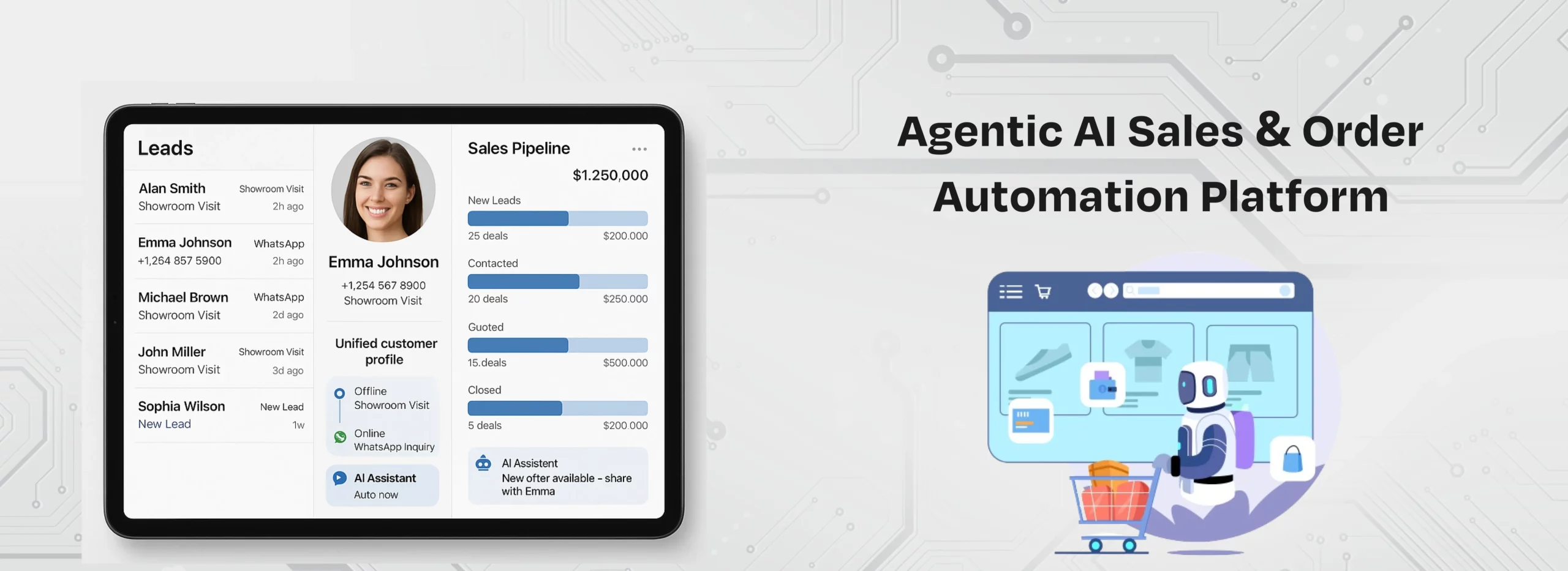
To address this, we designed and implemented an Agentic AI Sales & Order Automation Platform, a multi-agent system that orchestrates the entire sales journey from first inquiry to completed purchase. The platform intelligently captures customer inquiries across channels, understands requirements through AI-driven conversations, recommends suitable products, and generates accurate quotations automatically, ensuring faster and more consistent engagement.
Beyond recommendations and quoting, the system securely generates payment links or QR codes and tracks payment status in real time. For complex or high-value transactions, the platform seamlessly hands over context-rich insights to human sales teams.
The result is a scalable, intelligent sales automation framework that improves response speed, conversion efficiency, and customer experience while minimizing manual effort across the sales lifecycle.
Traditional Process
Before implementing the Agentic AI Sales & Order Automation Platform, the client relied on traditional, people-driven workflows to manage customer inquiries, quotations, and payments. As inquiry volumes increased across multiple channels, the absence of automation resulted in delays, inconsistencies, and limited visibility across the sales pipeline.
01
Fragmented Inquiry Handling
Customer inquiries from WhatsApp, Instagram, and Facebook were handled separately by sales teams. With no centralized system, conversations were scattered across channels, making it difficult to track customer intent and response timelines.
02
Requirement Collection Through Back-and-Forth Communication
Sales teams engaged in multiple follow-ups to understand customer needs, product preferences, quantities, and delivery expectations. Information was often incomplete or spread across chats and emails, leading to delays and repeated clarification cycles.
03
Experience-Based Product Suggestions
Product recommendations depended largely on individual sales experience rather than structured logic or customer context. This resulted in inconsistent recommendations and limited personalization across customer interactions.
04
Spreadsheet-Driven Quotation Preparation
Quotations were prepared using templates or spreadsheets, increasing the risk of pricing inconsistencies, outdated product details, and longer turnaround times, especially during peak inquiry periods.
05
Reactive Payment Follow-Ups
Payment links or QR codes were shared individually, and sales teams had to continuously follow up to confirm payment status. There was no real-time visibility into whether a payment was completed, pending, or abandoned.
06
Delayed Billing and Confirmation
Invoices and billing details were generated only after manual payment confirmation, adding further delays and increasing the chances of errors.
07
Limited Tracking and Reporting
Sales progress and payment status were tracked using spreadsheets or basic tools, offering minimal real-time visibility for leadership and making it difficult to identify bottlenecks or drop-offs in the sales journey.
Challenges Faced
As inquiry volumes increased across multiple digital channels, the client’s sales operations struggled to scale efficiently. The absence of automation and real-time visibility created friction across the sales journey, impacting both response speed and customer experience.
01
Fragmented Customer Inquiries
Customer conversations from WhatsApp, Instagram, and Facebook were scattered across channels, making it difficult to track intent, maintain continuity, and respond consistently.
02
Slow Response and Follow-Ups
Delayed responses and manual follow-ups during peak inquiry periods led to longer sales cycles and missed conversion opportunities.
03
Inconsistent Requirement Capture and Recommendations
Unstructured conversations resulted in incomplete requirement understanding and inconsistent product recommendations, reducing personalization and accuracy.
04
Quotation Delays and Pricing Errors
Manual quotation preparation increased turnaround time and introduced risks related to outdated pricing, calculation errors, and frequent revisions.
05
Limited Payment and Billing Visibility
Sales teams lacked real-time visibility into payment status and billing completion, relying on manual confirmation and repeated follow-ups after sharing payment links or QR codes.
06
Scalability Limitations
As inquiry volumes grew, the existing sales workflow could not scale without increasing operational effort, cost, and dependency on human intervention.
Our Solutions - Agentic AI Sales & Order Automation Platform
To overcome the limitations of the traditional sales workflow, we designed and implemented an Agentic AI Sales & Order Automation Platform that automates and orchestrates the entire sales journey. The system brings together multiple AI Agents that work collaboratively to manage inquiries, recommendations, quotations, payments, and post-payment communication in a unified flow.
01
Unified Multichannel Inquiry Capture
The agentic system centralizes customer inquiries from WhatsApp, Instagram, and Facebook into a single intelligent interface. This ensures consistent engagement, complete context retention, and faster response times across all channels.
02
AI-Based Visual Input Processing
Customers often share sample images, reference designs, or installation spaces through WhatsApp and Instagram. The system uses AI-powered image analysis to interpret visual inputs, identify product requirements, and map them to relevant catalog items, reducing the need for lengthy text-based explanations.
03
AI-Driven Requirement Understanding
Using conversational intelligence, the system analyzes customer interactions to accurately capture requirements such as product preferences, quantities, timelines, and intent, reducing back-and-forth communication and information gaps.
04
Intelligent Product Recommendations
Based on captured requirements and contextual signals, the system automatically recommends suitable products, ensuring consistent, relevant, and personalized suggestions across all customer interactions.
05
Automated Quotation Generation
The platform generates accurate, standardized quotations in real time, eliminating delays, pricing inconsistencies, and manual errors while improving turnaround time during high inquiry volumes.
06
Secure Payment and Billing Automation
The platform securely generates payment links or QR codes and tracks payment status in real time. Once payment details are verified through a Human in the Loop (HITL) process, the system assists in triggering invoice and billing workflows, ensuring a seamless, reliable, and controlled order closure process.
07
Multi-Agent Orchestration
The system is powered by a multi-agent architecture built on LangGraph, where specialized AI Agents handle distinct stages of the sales journey: inquiry capture, requirement analysis, product recommendation, quotation, payment, and follow-up. A central orchestrator coordinates these agents, ensuring smooth handoffs, context continuity, and end-to-end workflow automation without manual intervention.
08
Human-in-the-Loop Escalation
For complex, high-value, or sensitive transactions, the system seamlessly hands over complete context and insights to human sales teams, ensuring informed decision-making without disrupting the customer journey.
09
ERP Integration for Real-Time Product and Pricing Sync
The platform integrates directly with the client’s custom ERP system to pull real-time product availability, pricing, and inventory data. This ensures that recommendations and quotations always reflect the latest catalog, preventing errors from outdated information and keeping the AI Agents aligned with actual business operations.
Outcome
The implementation of the Agentic AI Sales & Order Automation Platform significantly transformed the client’s sales operations by centralizing customer interactions, reducing manual dependency, and accelerating the overall order-to-payment workflow. By combining AI-driven inquiry handling, intelligent product recommendations, quotation automation, payment tracking, and Human-in-the-Loop (HITL) validations, the solution improved operational efficiency, enhanced customer engagement, and enabled the client to scale sales processes more effectively across multiple digital channels.
Features
Multichannel Inquiry Capture
AI-based Visual Input Processing for Identifying Requirements
AI-Driven Requirement Understanding
Intelligent Product Recommendations
Automated Quotation Generation
Secure Payment Link & QR Code Generation
Real-Time Payment Tracking
Automated Billing & Invoice Generation
Multi-Agent Orchestration
Human-in-the-Loop Escalation
Centralized Sales Workflow Management
Scalable and Secure Architecture
Technologies Used

Backend
- Python
- FastAPI
Hosting
- AWS
- EC2

ERP Integration
- Custom ERP
AI Framework
- LangGraph
Database
- AWS RDS