Introduction
Choosing the right enterprise AI model has become a critical decision for business leaders in 2026. As organizations accelerate AI adoption across operations, analytics, customer support, and internal decision-making, the real challenge is no longer whether to use AI but which AI model best fits enterprise requirements around security, compliance, scalability, and integration.
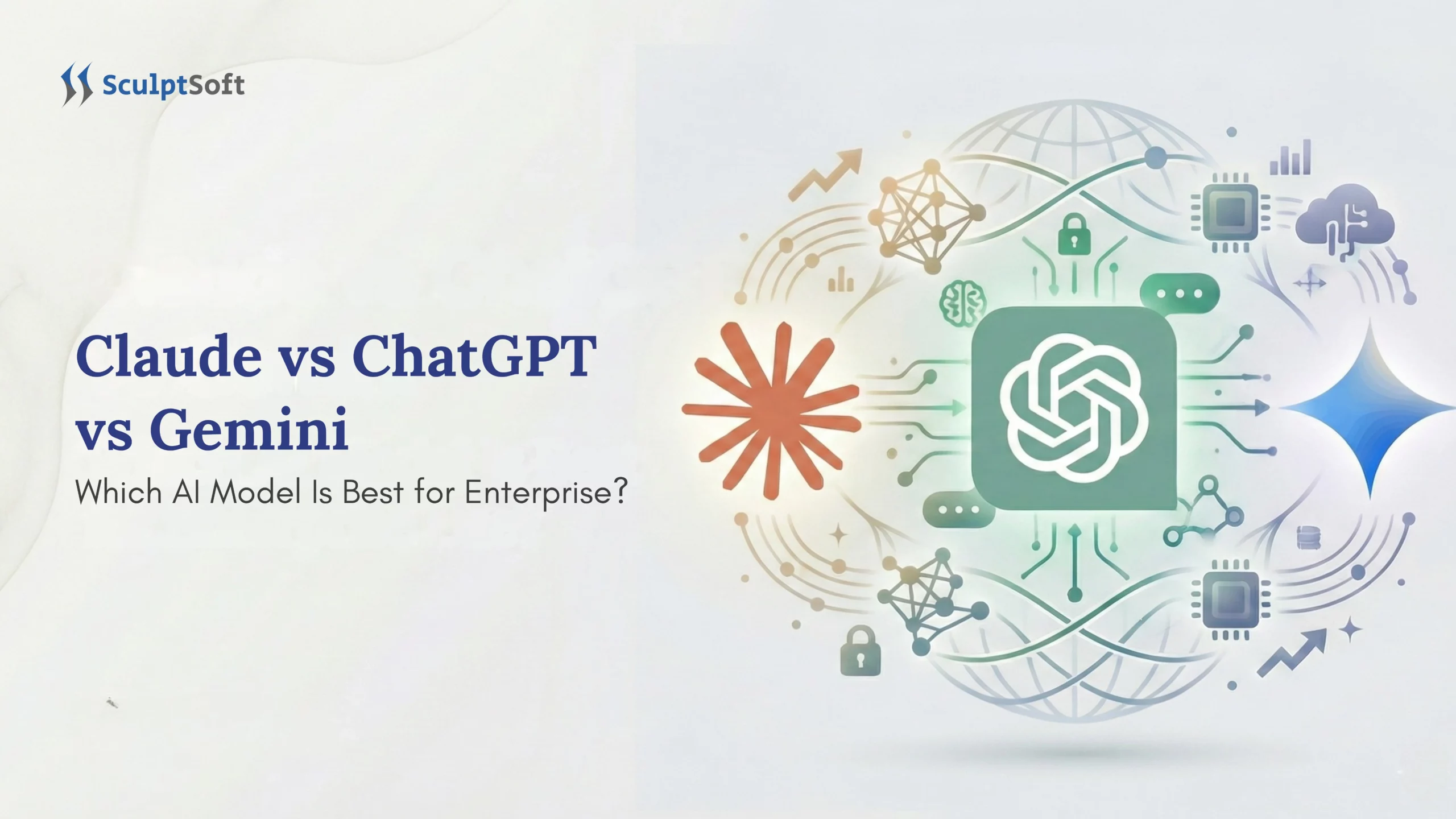
Today, most enterprises compare Claude vs ChatGPT vs Gemini when evaluating large language models for business use. Claude by Anthropic, ChatGPT by OpenAI, and Gemini by Google each offer powerful capabilities, but they are built with different priorities ranging from AI safety and long-context reasoning to ecosystem maturity and multimodal intelligence. Selecting the right model requires more than feature comparison; it demands an understanding of enterprise AI use cases, governance needs, data sensitivity, and long-term AI strategy.
This blog provides a practical, enterprise-focused comparison of Claude, ChatGPT, and Gemini. It helps business leaders and technology decision-makers evaluate which AI model is best for enterprise adoption based on real-world business needs, implementation complexity, cost considerations, and ROI enabling confident, future-ready AI decisions without vendor lock-in or operational risk.
Claude vs ChatGPT vs Gemini: Overview of Leading AI Models
Before comparing features in detail, enterprises must clearly understand what is Claude, what is ChatGPT, and what is Gemini because these AI models are built with different enterprise priorities. They are not interchangeable. Each model aligns with specific enterprise AI use cases depending on security and compliance needs, scalability, multimodal support, ecosystem compatibility, and long-term AI strategy.
What is Claude?
Claude is an enterprise-focused AI platform developed by Anthropic. Built on Constitutional AI principles, it embeds safety, reliability, and responsible behavior directly into the model’s design. Claude is designed to minimize hallucinations, handle sensitive data carefully, and produce structured, balanced responses.
What began as a model known primarily for long-context reasoning has evolved into a full enterprise product suite. Claude now includes Claude Cowork, an agentic assistant that handles complex knowledge work tasks autonomously across files and applications; Claude Code, a developer tool that writes, edits, and manages code directly from a codebase; and Claude Design, which turns plain-language descriptions
into working visual prototypes. Together, these products position Claude as a platform that covers the arc from analysis to execution to delivery.
Key strengths of Claude for enterprises:
- Long context window for contracts, compliance documents, and research
- Strong reasoning for legal, policy, and risk analysis
- Agentic capabilities for knowledge work automation through Cowork
- Safer and more predictable AI behavior across all products
- Flexible API-based deployment for custom enterprise systems
Claude is best suited for enterprises that prioritize AI safety, compliance, data privacy, and explainable decision-making, and increasingly for those seeking a unified AI platform for knowledge work, development, and productivity.
What is ChatGPT?
ChatGPT is a widely adopted enterprise AI platform developed by OpenAI, now powered by the GPT-5.5 model family. It is known for its versatility across a wide range of enterprise functions, including content creation, customer support, software development, automation, and internal productivity.
GPT-5.5, released in April 2026, marks a significant step forward for enterprise use. It is natively omnimodal, processing text, images, audio, and video within a single unified architecture, and is built to handle complex, multi-step tasks with less manual oversight. Rather than requiring carefully managed instructions at each step, GPT-5.5 can interpret an unclear problem, plan a path forward, use tools, and carry the work through to completion. OpenAI is also moving toward a unified platform combining ChatGPT, Codex, and an AI browser into a single enterprise service, reducing the need to switch between tools.
ChatGPT continues to stand out for its large ecosystem, extensive integrations, and strong developer adoption, making it one of the most accessible AI platforms for enterprises to deploy and scale quickly.
Key strengths of ChatGPT for enterprises:
- Strong performance across content generation, coding, and agentic workflows
- Native omnimodal capabilities across text, images, audio, and video
- Large plugin, API, and integration ecosystem
- Extensive documentation and enterprise tooling
- Fast deployment across multiple business teams
ChatGPT is ideal for enterprises seeking broad AI capabilities, faster time-to-value, and cross-department adoption, though it requires governance to ensure consistent and accurate AI usage at scale.
What is Gemini?
Gemini is a multimodal AI model developed by Google. Unlike text-first AI models, Gemini is built from the ground up to understand and reason across text, images, audio, video, and code making it a strong choice for enterprise multimodal AI use cases.
Gemini integrates deeply with Google Cloud Platform and Google Workspace, which makes it especially attractive for enterprises already operating within Google’s ecosystem.
Key strengths of Gemini for enterprises:
- Native multimodal AI capabilities
- Seamless integration with Google Cloud and Workspace
- Strong scalability and global infrastructure
- Better handling of real-time and search-based information
Gemini is best suited for enterprises focused on data-heavy environments, multimodal applications, and large-scale deployments within Google’s cloud infrastructure.
Comparing Claude, ChatGPT, and Gemini: What Matters Most for Enterprises
Selecting the right enterprise AI model is less about popularity and more about: fit with your workflows, security requirements, technical ecosystem, and long-term AI roadmap. Below is a clear, enterprise-focused comparison of Claude vs ChatGPT vs Gemini, highlighting practical differences that influence deployment success, cost control, and business outcomes.
1. Integration & Enterprise Setup
How easily an AI model integrates with your existing systems determines time-to-value.
- ChatGPT (OpenAI) integrates smoothly with common enterprise tools and offers mature, well-documented APIs for rapid rollout.
- Gemini (Google) fits naturally into Google Workspace and Google Cloud environments, reducing integration overhead for Google-first enterprises.
- Claude (Anthropic) provides clean, API-first integration, making it suitable for custom internal systems and controlled enterprise architectures.
2. Security, Compliance & Risk Control
Enterprise AI adoption must align with data protection and regulatory requirements.
- Claude emphasizes safe, predictable AI behavior and careful handling of sensitive data.
- ChatGPT Enterprise supports SOC 2, SSO, role-based access, and enterprise-grade data controls.
- Gemini benefits from Google Cloud’s established security certifications and compliance frameworks.
Best fit:
Highly regulated environments → Claude or Gemini
General enterprise compliance → ChatGPT
3. Language Understanding & Business Communication
Clear, consistent communication is critical for internal and external enterprise use.
- Claude produces structured, neutral, and policy-aligned responses.
- ChatGPT is more conversational and adaptable across teams and use cases.
- Gemini leverages real-time data but may vary in tone consistency.
4. Creativity & Content Generation
AI is widely used across marketing, HR, and communications teams.
- ChatGPT leads in creative writing, storytelling, and campaign ideation.
- Claude is stronger for professional, compliant, and structured content.
- Gemini supports data-informed content but is less expressive in tone.
5. Performance, Accuracy & Reasoning
Accuracy and reliability directly impact enterprise risk.
- Claude handles long-form documents and complex contextual analysis well.
- ChatGPT (GPT-4) excels in coding, logical reasoning, and structured problem-solving.
- Gemini performs well in real-time and multimodal scenarios.
6. Developer Experience & Customization
Developer adoption accelerates enterprise AI success.
- ChatGPT offers the richest ecosystem of tools, plugins, and documentation.
- Gemini aligns closely with Google’s developer and cloud stack.
- Claude provides stable APIs but fewer supporting development tools.
7. Cost & Scalability Considerations
Enterprise AI cost should be evaluated as total cost of ownership, not just token pricing.
- ChatGPT offers flexible, tiered pricing across different workloads
- Claude can be cost-efficient for long-context and document-heavy use cases.
- Gemini follows usage-based Google Cloud pricing, which scales well but requires monitoring.
Which AI Model Is Best for Your Enterprise?
Choosing the right AI model is a strategic enterprise decision, not a feature comparison exercise. There is no single “best” AI for all businesses. The right choice depends on your industry, data sensitivity, workflows, technical readiness, and long-term AI roadmap. Below is a clear guide to help you decide between Claude vs ChatGPT vs Gemini based on real enterprise needs.
When to Choose Claude
Choose Claude when your enterprise needs AI that is controlled, explainable, and reliable and increasingly, when you need a unified platform that can handle the full scope of knowledge work, not just analysis.
Claude remains the strongest fit for regulated and risk-sensitive environments where AI outputs must be accurate, structured, and auditable. Its Constitutional AI foundation makes it the most predictable of the three platforms at scale. But with the addition of Claude Cowork, Code, and Design, it has expanded well beyond that original positioning.
Claude is a strong fit if your use cases include:
- Processing long documents such as contracts, policies, clinical records, or audit reports
- Supporting legal, healthcare, finance, or compliance-heavy workflows
- Requiring neutral tone, structured responses, and reduced hallucination risk
- Delegating complex knowledge work tasks across files, applications, and multi-step workflows through Cowork
- Building or modernizing software through Claude Code, which handles autonomous, long-horizon coding tasks
- Translating ideas into visual prototypes or design assets through Claude Design
- Building custom internal AI tools with flexibility and minimal vendor lock-in
Claude works best where accuracy, context preservation, and autonomous execution matter whether that is a compliance team processing regulatory documents, an operations team delegating repetitive knowledge work, or a development team handling large-scale code tasks.
When to Choose ChatGPT
Choose ChatGPT when your enterprise needs a general-purpose AI platform that can be deployed quickly across multiple departments. It is ideal for organizations starting their enterprise AI journey or scaling AI usage broadly without heavy customization upfront.
ChatGPT is a strong fit if your enterprise needs:
- AI across marketing, customer support, development, HR, and operations
- Strong performance in content creation, coding, automation, and reasoning
- Access to a large ecosystem of integrations, plugins, and tools
- Faster time-to-value with proven enterprise adoption patterns
ChatGPT is best when execution speed, flexibility, and broad adoption drive business value supported by governance to maintain consistency.
When to Choose Gemini
Choose Gemini when your enterprise relies heavily on Google Cloud, Google Workspace, or data-driven workflows and requires AI that can work across multiple data types.
Gemini is ideal if your use cases involve:
- Multimodal AI (text, images, video, audio, and code together)
- Real-time information access and research-driven workflows
- Large-scale, data-heavy environments already built on Google Cloud
- Global deployment with high scalability and infrastructure reliability
Gemini works best for enterprises where multimodal intelligence and Google ecosystem integration are strategic advantages.
Quick Decision Guide: Claude vs ChatGPT vs Gemini
| Use Case / Business Priority | Best AI Model | Why It Fits |
|---|---|---|
| Enterprise-wide AI adoption | ChatGPT | Broad usability, ecosystem maturity, and fast cross-department deployment |
| Compliance-heavy industries | Claude | Strong safety controls, structured output, and predictable AI behavior |
| Coding and automation | ChatGPT or Claude | ChatGPT for broad developer tooling and integrations; Claude Code for autonomous, long-horizon coding tasks |
| Creative and marketing content | ChatGPT | Strong storytelling, brand voice adaptability, and content generation |
| Financial or legal documentation | Claude | Neutral tone, long-context accuracy, and reduced hallucination risk |
| Knowledge work automation | Claude | Claude Cowork handles multi-step tasks across files and applications autonomously |
| Real-time research or education | Gemini or Claude | Gemini for live data and search-grounded responses; Claude for structured depth |
| Multimodal data processing | Gemini | Deepest Google Cloud integration; GPT-5.5 also supports omnimodal processing for non-Google environments |
Use Case / Business Priority
Enterprise-wide AI adoption
Best AI Model
ChatGPT
Why It Fits
Broad usability, ecosystem maturity, and fast cross-department deployment.
Use Case / Business Priority
Compliance-heavy industries
Best AI Model
Claude
Why It Fits
Strong safety controls, structured output, and predictable AI behavior
Use Case / Business Priority
Coding and automation
Best AI Model
ChatGPT or Claude
Why It Fits
ChatGPT for broad developer tooling and integrations; Claude Code for autonomous, long-horizon coding tasks
Use Case / Business Priority
Creative and marketing content
Best AI Model
ChatGPT
Why It Fits
Strong storytelling, brand voice adaptability, and content generation
Use Case / Business Priority
Financial or legal documentation
Best AI Model
Claude
Why It Fits
Neutral tone, long-context accuracy, and reduced hallucination risk
Use Case / Business Priority
Knowledge work automation
Best AI Model
Claude
Why It Fits
Claude Cowork handles multi-step tasks across files and applications autonomously
Use Case / Business Priority
Real-time research or education
Best AI Model
Gemini or Claude
Why It Fits
Gemini for live data and search-grounded responses; Claude for structured depth
Use Case / Business Priority
Multimodal data processing
Best AI Model
Gemini
Why It Fits
Deepest Google Cloud integration; GPT-5.5 also supports omnimodal processing for non-Google environments
How SculptSoft Helps Enterprises Implement Custom AI Solutions
Implementing AI at scale requires more than selecting between Claude, ChatGPT, or Gemini. Enterprises need custom AI solutions that align with business workflows, data architecture, security standards, and long-term growth plans. SculptSoft helps organizations design and deploy enterprise AI solutions that move beyond experimentation and deliver measurable business outcomes across operations, analytics, customer experience, and decision support.
SculptSoft specializes in custom AI development and enterprise AI integration, ensuring the right AI model is applied to the right use case whether that means long-context AI for compliance, generative AI for automation and productivity, or multimodal AI solutions for data-rich environments. Our solutions are built to integrate seamlessly with existing cloud platforms, data pipelines, and enterprise systems while remaining flexible and vendor-neutral.
How we support enterprise AI adoption:
- Custom AI solution design aligned with business objectives
- AI model selection and optimization (Claude, ChatGPT, Gemini)
- Secure enterprise AI integration across cloud and on-prem systems
- AI governance, compliance, and data security frameworks
- Ongoing optimization, scaling, and performance monitoring
With SculptSoft, enterprises gain a strategic AI partner not just an implementation vendor, helping them build scalable, secure, and future-ready AI services and solutions that deliver long-term value.
Conclusion
Choosing the right enterprise AI model – Claude, ChatGPT, or Gemini is not about finding a one-size-fits-all solution. It’s about selecting the AI platform that best aligns with your business goals, data sensitivity, technology stack, and long-term AI strategy. Claude stands out for compliance, safety, and long-context intelligence, ChatGPT excels in versatility and ecosystem maturity, and Gemini is ideal for multimodal AI and Google Cloud–centric environments. The real differentiator, however, lies in how effectively these models are implemented and governed within your enterprise.
This is where SculptSoft helps enterprises turn AI decisions into measurable outcomes through custom AI development, secure enterprise AI integration, governance-ready architectures, and scalable AI solutions tailored to real business use cases.
Looking to implement the right AI model for your enterprise?
Talk to our AI Experts to design, build, and scale custom AI solutions that deliver real ROI, not just experimentation.
Frequently Asked Questions
Which AI model is best for enterprise use: Claude, ChatGPT, or Gemini?
There is no single best AI model for all enterprises. Claude is ideal for compliance-heavy and regulated environments, ChatGPT is best for broad enterprise adoption and productivity, and Gemini excels in multimodal and Google Cloud–centric enterprise use cases. The right choice depends on data sensitivity, workflows, and long-term AI strategy.
What are the key differences between Claude, ChatGPT, and Gemini for enterprises?
The main differences lie in security, context handling, ecosystem integration, and use-case fit. Claude focuses on safe and structured reasoning with long-context support, ChatGPT offers versatility and fast deployment across teams, and Gemini provides native multimodal AI with deep Google Cloud integration.
Is Claude better than ChatGPT for regulated industries like finance or healthcare?
Yes. Claude, developed by Anthropic, is often preferred in regulated industries because of its emphasis on AI safety, predictable behavior, reduced hallucinations, and long-document reasoning. It is well-suited for legal, healthcare, compliance, and risk-sensitive enterprise workflows.
Why do enterprises choose ChatGPT for large-scale AI adoption?
Enterprises choose ChatGPT because of its flexibility, strong performance across content creation, coding, and automation, and its mature ecosystem built by OpenAI. It enables faster time-to-value and easy cross-department adoption with proper governance.
When is Gemini the right AI model for enterprise applications?
Gemini, built by Google, is the right choice when enterprises need multimodal AI, real-time information handling, or seamless integration with Google Cloud and Google Workspace. It is especially effective in data-heavy, large-scale, and cloud-native enterprise environments.
How should enterprises evaluate AI model costs and ROI?
Enterprises should evaluate AI models based on total cost of ownership, not just token pricing. This includes integration effort, governance overhead, scalability, performance accuracy, and long-term ROI. Claude can be cost-effective for long-context use cases, ChatGPT offers flexible pricing tiers, and Gemini scales well under Google Cloud’s usage-based pricing.
Can enterprises use Claude, ChatGPT, and Gemini together?
Yes. Many enterprises adopt a multi-model AI strategy, using Claude for compliance and document intelligence, ChatGPT for productivity and automation, and Gemini for multimodal or Google-centric workflows. This approach reduces vendor lock-in and aligns each AI model with the use cases it performs best.