Introduction
Finding and retaining skilled AI developers has become a critical challenge for modern enterprises. As organizations push forward with initiatives such as machine learning automation, agentic AI systems, predictive analytics, and large language model (LLM) integration, the demand for highly specialized AI talent continues to outpace supply. Traditional hiring models often involve long recruitment cycles, high salary commitments, onboarding delays, and significant long-term overhead slowing down innovation at the very moment speed matters most.
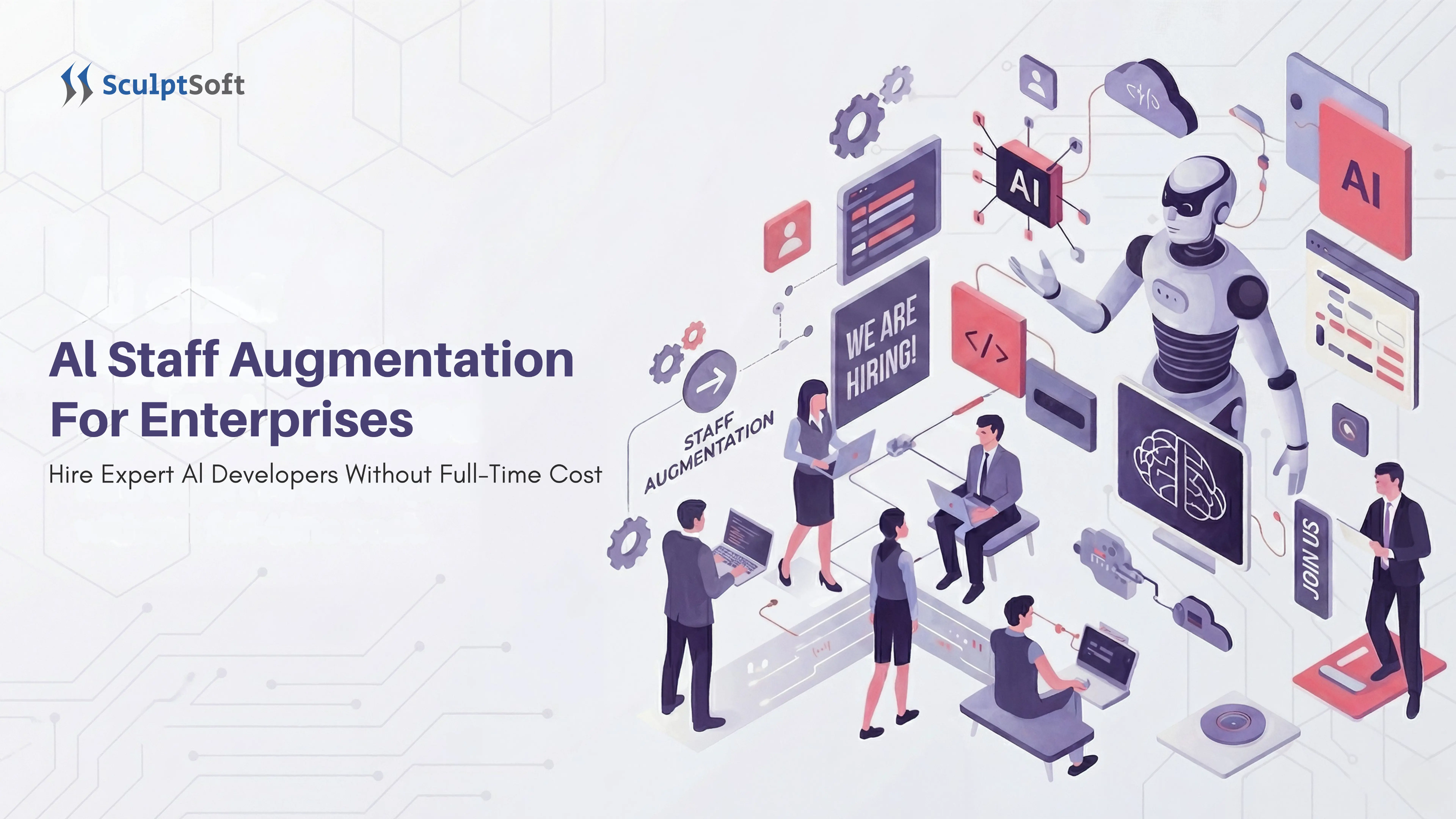
AI staff augmentation presents a more strategic and scalable alternative. Instead of committing to permanent hires, enterprises can access experienced AI developers, data scientists, and AI engineers on demand aligned precisely with project scope, timelines, and business priorities. This model allows organizations to quickly expand AI capabilities, accelerate time-to-market, and maintain cost efficiency without compromising on technical depth or delivery quality.
By leveraging AI staff augmentation, enterprises gain the flexibility to scale teams up or down, adopt emerging AI technologies faster, and reduce the risk associated with long-term hiring in a rapidly evolving AI landscape. Whether the goal is building production-ready AI systems, modernizing existing platforms with intelligent automation, or experimenting with advanced AI use cases, staff augmentation enables focused execution without operational friction.
In this blog, we’ll break down how AI staff augmentation works, why it’s becoming a preferred model for organizations nowadays, and how enterprises can use it to build high-impact AI solutions while maintaining financial and operational agility. If your organization is looking for a practical way to strengthen its AI initiatives without long-term hiring constraints, this guide will help you make an informed decision.
Why Enterprises Are Struggling to Hire AI Developers
Enterprises across industries are facing increasing difficulty in building and scaling AI teams through traditional hiring. As artificial intelligence becomes central to digital transformation, automation, and data-driven decision-making, the gap between AI talent demand and availability continues to widen. This imbalance creates operational, financial, and strategic challenges for organizations attempting to execute AI initiatives at speed.
Extended and Inefficient Hiring Cycles
Hiring AI developers is rarely a quick process. Enterprises must define complex role requirements, source niche profiles, screen large volumes of candidates, run multiple technical and stakeholder interviews, and navigate lengthy onboarding timelines. By the time an AI engineer joins, business priorities or technology stacks may have already shifted. In competitive markets, these delays slow innovation and reduce an organization’s ability to respond to emerging opportunities.
-
Total Employment Cost Extends Beyond Compensation
Full-time AI hiring involves much more than base pay. Enterprises must account for employee benefits, infrastructure, tools, licenses, continuous upskilling, and long-term workforce commitments. When combined, these overheads significantly increase the total cost of ownership for in-house AI talent, often without guaranteeing immediate productivity or alignment with short-term project goals.
-
Highly Specialized and Evolving Skill Requirements
AI development is not a single skillset. Enterprises often require different expertise across machine learning engineering, natural language processing, computer vision, generative AI, agentic AI systems, MLOps, and large language model integration. Hiring permanent staff with highly specific expertise for short-term or evolving AI use cases is inefficient. Skills that are critical for one initiative may become underutilized once the project is delivered.
-
Intense Competition for Experienced AI Talent
Large enterprises, global technology firms, and innovation-driven startups are all competing for the same limited pool of experienced AI professionals. Many senior AI developers now prefer flexible engagement models such as consulting or contract-based work, which reduces interest in long-term, traditional employment. This makes it even harder for enterprises to secure and retain top-tier AI talent through standard hiring channels.
-
Traditional Hiring No Longer Matches AI Execution Speed
AI initiatives demand speed, adaptability, and rapid experimentation. Traditional hiring models are often too rigid and slow to support modern AI development cycles. As a result, enterprises struggle to build AI capabilities quickly, scale teams efficiently, or control risk and cost through permanent hiring alone.
As enterprises seek faster and more adaptable ways to build AI capabilities beyond the limits of traditional hiring, AI staff augmentation offers a practical approach to accessing specialized AI talent, integrating it seamlessly with internal teams, and scaling development efforts without long-term commitments.
What Is AI Staff Augmentation?
AI staff augmentation is a flexible hiring model that enables enterprises to bring in specialized AI developers on a temporary or project-based basis without committing to full-time employment. This approach allows organizations to strengthen their internal teams with on-demand AI expertise while maintaining control over architecture, processes, and delivery outcomes.
Rather than expanding permanent headcount, enterprises use AI staff augmentation to accelerate AI development, address skill gaps, and support initiatives such as machine learning platforms, generative AI applications, agentic AI systems, and intelligent automation without adding long-term operational complexity.
How AI Staff Augmentation Works
With AI staff augmentation, enterprises partner with a specialized provider that supplies vetted AI developers aligned to their technical requirements. These professionals work directly with your in-house teams, follow your development processes, and operate under your leadership and project management structure.
While augmented developers function as an extension of your internal team, the staff augmentation partner manages employment-related responsibilities such as recruitment, onboarding, compliance, payroll, benefits, and ongoing administrative support. This allows enterprises to stay focused on execution, outcomes, and innovation without the complexity of managing additional full-time staff.
How AI Staff Augmentation Differs from Traditional Hiring
Traditional hiring requires enterprises to take full ownership of long-term employment commitments, workforce planning, and operational overhead. AI staff augmentation removes these constraints by offering immediate access to skilled AI talent without the administrative burden.
This model also differs from outsourcing or consulting. Unlike consultants who typically deliver predefined outputs with limited integration, augmented AI developers work inside your teams, collaborate daily with stakeholders, and adapt in real time as project requirements evolve. This ensures greater transparency, alignment, and continuity throughout the AI development lifecycle.
Common AI Staff Augmentation Engagement Models
Project-Based AI Augmentation
This model is ideal for clearly defined AI initiatives with specific goals and timelines, such as building a proof of concept, deploying a machine learning pipeline, or integrating large language models. Enterprises scale teams for the duration of the project and disengage once objectives are achieved.
Dedicated AI Team Model
A dedicated team model provides consistent, long-term AI development support. Augmented developers work exclusively on your projects, gaining deep domain knowledge while allowing enterprises to scale team size based on workload, technology needs, or business priorities.
Hybrid Augmentation Approach
Many enterprises adopt a hybrid model maintaining a small core of in-house AI talent while supplementing it with augmented specialists for niche expertise, emerging technologies, or peak demand periods. This approach balances stability with flexibility and ensures efficient use of AI resources.
7 Reasons Why Leading Enterprises Choose AI Staff Augmentation
As AI initiatives become more complex and business-critical, enterprises are rethinking how they build and scale AI teams. AI staff augmentation has emerged as a preferred model because it delivers flexibility, speed, and efficiency that traditional hiring often cannot match. Below are the key 7 reasons why large organizations increasingly adopt this approach.
1. Optimized Cost Efficiency
AI staff augmentation helps enterprises control development costs by avoiding long-term employment overhead. Instead of managing expenses related to benefits, recruitment cycles, infrastructure, and idle capacity, organizations pay only for the skills and time required for active AI projects. This cost-efficient model allows enterprises to allocate budgets more strategically and invest in higher-impact AI initiatives.
2. Faster Access to Experienced AI Talent
Traditional hiring for AI roles can take months, slowing down innovation and delivery. With AI staff augmentation, enterprises can onboard skilled AI developers much faster, enabling teams to respond quickly to new opportunities, accelerate AI product development, and maintain competitive momentum in fast-moving markets.
3. On-Demand Access to Specialized AI Expertise
AI development spans multiple advanced domains, including generative AI, agentic AI systems, machine learning engineering, computer vision, natural language processing, and domain-specific AI solutions. Maintaining permanent experts across all these areas is rarely practical. Staff augmentation allows enterprises to bring in specialized AI professionals precisely when specific expertise is required, without long-term dependency.
4. Flexible and Scalable Team Structures
Enterprise AI workloads fluctuate based on project phases, innovation cycles, and strategic priorities. AI staff augmentation enables organizations to scale teams up or down seamlessly, aligning resources with real-time needs. This adaptability is especially valuable for enterprises running multiple AI initiatives with varying timelines and technical requirements.
5. Reduced Administrative and Management Overhead
Managing full-time AI teams involves significant operational responsibilities, including HR processes, performance management, training, and workforce planning. With AI staff augmentation, these administrative tasks are handled by the augmentation partner, allowing internal leaders to focus on delivery, innovation, and measurable business outcomes rather than talent administration.
6. Lower Engagement and Delivery Risk
AI projects often evolve rapidly as technologies, data strategies, or business goals change. Staff augmentation reduces long-term risk by providing flexibility to adjust team composition, skill sets, or engagement scope without the complexity of permanent hiring decisions. This model allows enterprises to adapt confidently as AI strategies mature.
7. Stronger Focus on Core Business Strategy
Building and managing large in-house AI teams can divert leadership attention from core business objectives. AI staff augmentation enables enterprises to access high-quality AI development capabilities while keeping strategic focus on growth, innovation, and competitive differentiation. Talent management remains streamlined, while AI execution stays aligned with business goals.
How to Implement AI Staff Augmentation in Your Enterprise (Step-by-Step)
Implementing AI staff augmentation successfully requires more than just adding external talent. Enterprises that see the best results follow a structured approach that aligns business goals, technical needs, and execution processes. Below is a practical, step-by-step roadmap to help you get it right.
Step 1: Clearly Define Your AI Requirements
Start with clarity on why you are using AI staff augmentation. Identify the specific business problem you want to solve, the AI use case you are targeting, and the outcomes you expect. Clear goals make it easier to select the right skills and measure success.
Next, outline your technical requirements. Determine whether you need machine learning engineers, AI developers, data scientists, or specialists in areas such as generative AI, agentic AI systems, natural language processing, or computer vision. Also consider required experience with AI frameworks, cloud platforms, data pipelines, or deployment environments.
Domain expertise is equally important. AI developers with prior exposure to industries such as healthcare, finance, manufacturing, or retail can understand constraints faster and deliver more relevant solutions.
Step 2: Choose the Right AI Staff Augmentation Partner
Not all AI staff augmentation providers offer the same depth of expertise. Look for partners with proven experience in enterprise AI development and a strong track record across relevant technologies.
Evaluate how the provider vets AI talent, ensures code quality, and supports ongoing performance. Communication and collaboration practices matter, understand how teams coordinate, share updates, and handle time zone alignment if teams are distributed.
Security, compliance, and data protection should be non-negotiable. Ensure the provider can align with your internal security standards, regulatory requirements, development tools, and intellectual property policies.
Step 3: Set Up a Clear Engagement and Team Structure
A well-defined engagement structure prevents friction later. Clearly document scope, responsibilities, timelines, and expected outcomes. Define the team composition, including roles, experience levels, and reporting structure.
Address intellectual property ownership and confidentiality upfront. All work produced should clearly belong to your enterprise, with safeguards for sensitive data and proprietary information.
Establish management and escalation processes early. Define points of contact, reporting cadence, performance expectations, and how scaling or replacement will be handled if needs change.
Step 4: Onboard AI Developers into Your Existing Team
Treat augmented AI developers as an extension of your internal team. Provide access to the required tools, systems, and documentation. Share context about your business objectives, AI roadmap, development standards, and quality expectations.
Introduce them to key stakeholders, workflows, and communication channels. Clear onboarding helps developers become productive faster and ensures alignment from the start.
Define roles, decision-making authority, and escalation paths so everyone understands how collaboration works and where to go for support.
Step 5: Track Performance and Measure Business Impact
Ongoing management is essential for long-term success. Schedule regular check-ins to review progress, address blockers, and maintain alignment with business goals. Use shared collaboration and tracking tools so augmented and internal teams work transparently.
Provide continuous feedback to both the developers and the augmentation partner. Open communication helps resolve issues early and improves overall delivery quality.
Track success metrics from the beginning. These may include delivery timelines, solution quality, system performance, business impact, or operational efficiency. Measuring outcomes consistently helps enterprises validate ROI and optimize future engagements.
What to Look for in an AI Staff Augmentation Partner
Choosing the right AI staff augmentation partner plays a critical role in the success of your enterprise AI initiatives. Beyond access to talent, the right partner brings technical depth, security maturity, operational alignment, and long-term flexibility. Below are the key factors enterprises should evaluate before selecting an AI staff augmentation provider.
-
Deep AI and Technical Expertise
A reliable AI staff augmentation partner should demonstrate hands-on expertise across the AI technologies relevant to your use cases. This may include machine learning engineering, generative AI solutions, agentic AI systems, large language model integration, natural language processing, and computer vision.
Rather than relying on high-level claims, evaluate real experience. Ask for examples of similar enterprise AI projects, technical discussions with AI developers, or insights into how complex challenges were solved. Providers with genuine expertise are transparent and confident in showcasing their technical capabilities.
-
Enterprise-Grade Security and Compliance
Security and compliance are essential for enterprise AI development. Your partner should follow strong data protection practices, support secure development workflows, and have experience working within regulatory environments such as healthcare, finance, or data-sensitive industries.
Look for partners that understand compliance requirements, intellectual property protection, and secure handling of sensitive data. Proven experience delivering compliant AI solutions for other enterprises is a strong indicator of reliability.
-
Proven Experience with Enterprise Environments
Enterprise AI projects differ significantly from small-scale development. They involve complex systems, multiple stakeholders, integration challenges, and higher expectations around delivery standards.
An experienced AI staff augmentation partner understands enterprise workflows, approval processes, and communication expectations. Review case studies, long-term client relationships, and repeat engagements to assess their ability to deliver consistent value in enterprise settings.
-
Clear and Transparent Communication
Strong communication is a foundation of successful AI staff augmentation. Your partner should offer clear points of contact, structured reporting, and proactive issue management.
Understand how project updates are shared, how collaboration is managed, and how challenges are escalated. The best partners treat communication and project coordination as core services, ensuring alignment throughout the engagement.
-
Flexibility and Scalability
Enterprise AI needs to change over time. A good AI staff augmentation provider can scale teams up or down as requirements evolve, support multiple AI initiatives, and adapt quickly to new priorities.
Flexibility also means aligning with your internal processes, tools, and workflows instead of forcing rigid delivery models. Adaptability is key to sustaining long-term AI success.
-
Strategic Technology Partnerships
Partnerships with major cloud and technology platforms often signal technical maturity and enterprise readiness. For example, partnerships with leading cloud providers demonstrate experience in scalable AI infrastructure, security best practices, and modern AI deployment architectures.
Such partnerships can add value through improved solution design, access to advanced tooling, and alignment with enterprise technology ecosystems.
-
Clear Ownership and No Vendor Lock-In
A trustworthy AI staff augmentation partner ensures full ownership of intellectual property remains with your enterprise. Contracts should be transparent, flexible, and allow you to disengage or transition if business needs change.
Quality providers build long-term relationships by delivering results and earning trust not by creating dependency. Clear exit terms and knowledge transfer practices reflect confidence and professionalism.
Common Concerns About AI Staff Augmentation (And How to Address Them)
Many enterprises see the value of AI staff augmentation but still have practical concerns before moving forward. These concerns are valid and when addressed correctly, they do not become barriers. Below are the most common enterprise concerns and how to handle them effectively.
1. Intellectual Property and Data Protection
The Concern:
Enterprises worry about protecting intellectual property, proprietary code, and sensitive business data when working with external AI developers.
How to Address It:
Establish clear contracts that state all code, documentation, and work output belongs to your enterprise. Use strong non-disclosure agreements that cover technical, operational, and strategic information. Operationally, control access to systems, repositories, and data so augmented developers only see what is necessary. Reputable AI staff augmentation providers are familiar with these requirements and support enterprise-grade IP protection.
2. Code Quality and Accountability
Enterprises may worry that externally sourced AI developers won’t meet internal quality standards or delivery expectations.
Define quality standards upfront, including coding guidelines, testing practices, documentation requirements, and review processes. Treat augmented developers the same as internal team members when it comes to expectations and accountability. Include replacement and escalation clauses in the engagement terms, and conduct regular code reviews to maintain consistency and quality.
3. Communication and Team Alignment
The Concern:
Communication challenges, especially with distributed or global teams, can impact collaboration and delivery.
Choose an AI staff augmentation partner with clear communication processes and responsive coordination. Use shared collaboration tools, regular check-ins, and documented workflows. Clear expectations, structured communication, and professional working practices matter far more than physical location or time zones.
4. Integration with Internal Teams
Augmented developers may feel disconnected from internal teams, slowing collaboration.
Integrate augmented AI developers into daily workflows from day one. Include them in planning sessions, standups, reviews, and team discussions. Provide access to the same tools, documentation, and context as internal team members. When treated as part of the team, integration happens naturally and productivity improves quickly.
5. Knowledge Transfer and Continuity
Enterprises worry about losing knowledge once an augmentation engagement ends.
Make knowledge transfer part of the engagement plan from the start. Require clear documentation of code, architecture, and decisions throughout the project. Schedule regular knowledge-sharing sessions and final walkthroughs before transition. This ensures long-term maintainability and reduces dependency on individual contributors.
Why SculptSoft Is Your Ideal AI Staff Augmentation Partner
With experience across regulated and data-intensive industries, our AI teams understand enterprise security, compliance, and operational requirements. As an AWS Select Tier Partner, we work within cloud-first, secure AI architectures and follow best practices aligned with standards such as HIPAA and GDPR, making our AI staff augmentation approach suitable for sensitive and mission-critical projects.
Our engagement model emphasizes transparency and flexibility. Enterprises retain full ownership of intellectual property, and teams can scale based on project needs. For organizations evaluating long-term AI staffing strategies, our AI staff augmentation services provide a practical way to validate expertise, accelerate delivery, and support AI initiatives without vendor lock-in.
Conclusion
Building and scaling AI capabilities no longer needs to depend on slow, rigid hiring models. As AI development becomes more specialized and fast-moving, enterprises need flexible ways to hire AI developers without long-term commitments. AI staff augmentation enables organizations to accelerate AI initiatives, adapt to evolving technologies, and align talent with real business needs.
This guide showed how AI staff augmentation helps enterprises overcome hiring delays, access specialized AI expertise, and scale AI teams efficiently across machine learning, generative AI, and agentic AI initiatives while maintaining agility, cost control, and reduced risk.
As a leading AI software development company, we help enterprises hire AI developers through staff augmentation with flexible engagement models and secure, scalable delivery, connect with our team to hire AI developers faster and scale your enterprise AI initiatives with confidence.
Frequently Asked Questions
How quickly can I hire AI developers through staff augmentation?
Most quality staff augmentation providers can have developers working on your project within two to four weeks. This includes understanding your requirements, matching you with appropriate talent, and completing onboarding. This is dramatically faster than traditional hiring, which typically takes four to six months for AI roles.
Is AI staff augmentation cost-effective compared to full-time hiring?
Yes. Most enterprises find that staff augmentation reduces AI development costs significantly when accounting for total cost of ownership. You avoid benefits overhead, recruitment costs, equipment expenses, and idle time costs. Savings typically range from 40-60% compared to full-time hiring.
Can I hire AI developers for short-term projects?
Absolutely. Staff augmentation excels at short-term and project-based work. You can bring in specialized talent specifically for defined projects without any long-term commitment. When the project completes, the engagement can end without the complications of traditional employment.
What types of AI developers can be hired through staff augmentation?
Through AI staff augmentation, enterprises can hire machine learning engineers, AI developers, data scientists, generative AI specialists, LLM integration experts, MLOps engineers, and agentic AI specialists, depending on project needs and technology requirements.
Is AI staff augmentation secure for enterprise and regulated industries?
Yes, AI staff augmentation can be secure when working with experienced providers that follow enterprise-grade security practices, support compliance requirements like HIPAA and GDPR, and ensure clear intellectual property ownership. Access controls, NDAs, and secure development workflows are standard best practices.