Introduction
Enterprise AI has entered a new phase.
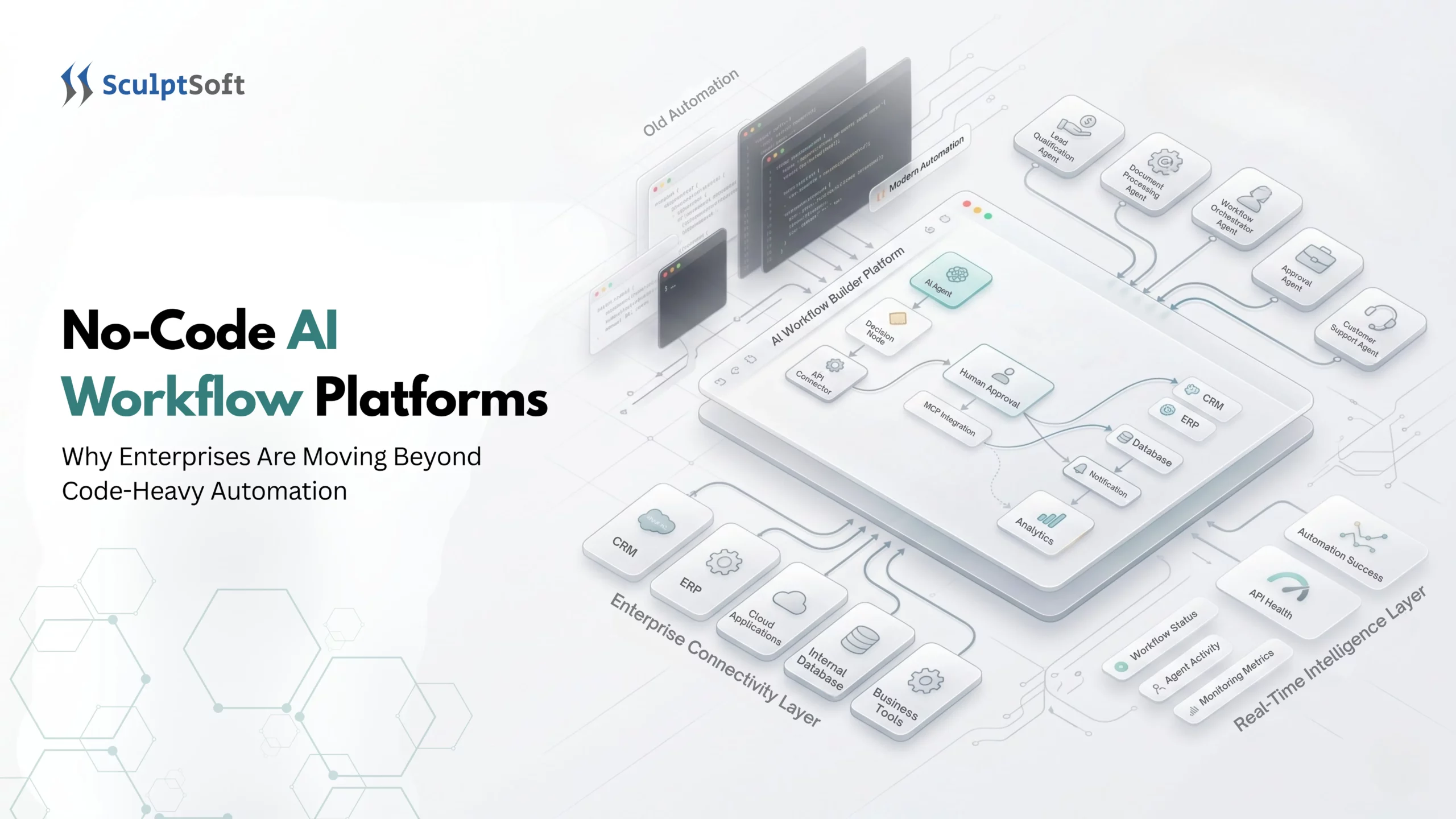
What is a no-code AI workflow platform? A no-code AI workflow platform is a software solution that enables businesses to build, automate, and manage AI-powered workflows using visual drag-and-drop interfaces instead of traditional programming. These platforms integrate with Large Language Models (LLMs), business applications, APIs, and databases, allowing organizations to deploy AI automation faster while reducing development and maintenance costs.
Just a few years ago, organizations viewed AI primarily as a technology project requiring specialized data scientists, machine learning engineers, DevOps experts, and software developers. Every automation initiative demanded custom APIs, complex orchestration logic, infrastructure provisioning, and months of engineering effort.
Today, the conversation has changed.
Business leaders no longer ask:
“Can we build AI?”
Instead, they ask:
“How quickly can AI solve our business problems?”
Many organizations are accelerating this transition by partnering with experienced providers of AI solutions that can design, integrate, and scale intelligent workflows while aligning with enterprise security and governance requirements.
Many organizations are accelerating this transition by partnering with experienced providers of AI solutions that can design, integrate, and scale intelligent workflows while aligning with enterprise security and governance requirements.
This shift is driving the rapid adoption of no-code AI workflow platforms, which allow enterprises to automate complex processes without relying entirely on traditional software development.
Whether it’s customer support, document processing, sales automation, HR onboarding, or knowledge management, organizations increasingly prefer configurable AI workflows over building everything from scratch.
For example, one enterprise reduced manual operational effort dramatically after implementing AI-powered workflow automation, demonstrating how modern AI solutions can replace time-consuming manual processes.
According to industry research from Gartner, McKinsey, Deloitte, and IDC, enterprises are prioritizing AI platforms that improve speed to value, reduce implementation costs, and enable business users to participate in automation initiatives. The emphasis is no longer just on AI capabilities but on operational efficiency, governance, and measurable business outcomes.
Why Enterprises Are Moving Away from Code-Heavy AI Automation
Building custom AI systems was once considered the gold standard for enterprise innovation. Organizations invested heavily in engineering talent to create bespoke machine learning pipelines, integrate APIs, and orchestrate business logic tailored to their operations.
While custom development provides maximum flexibility, it also introduces significant challenges that become more pronounced as AI adoption expands across departments.
1. Rising Development Costs
Creating an enterprise AI workflow often involves multiple specialists:
- Backend developers
- Frontend developers
- AI engineers
- Data scientists
- DevOps engineers
- Cloud architects
- Security specialists
- QA engineers
Each additional role increases project costs and coordination complexity.
What begins as a straightforward automation initiative can evolve into a large-scale engineering project with escalating budgets and extended timelines.
2. Long Implementation Cycles
Traditional AI workflow development frequently takes several months before reaching production.
This timeline includes:
- Requirement gathering
- Architecture design
- API integration
- Infrastructure setup
- Security reviews
- Model integration
- Testing
- Deployment
- User acceptance testing
In rapidly changing markets, such delays can reduce the competitive advantage of AI initiatives.
3. Growing Maintenance Burden
“The organizations gaining the greatest value from AI aren’t necessarily building the most sophisticated models they’re integrating AI into everyday business workflows where it consistently improves productivity and decision-making.”
McKinsey & Company · The State of AI
AI systems evolve continuously as APIs, LLMs, business rules, and compliance requirements change. Without ongoing maintenance, custom workflows quickly become outdated, forcing engineering teams to spend more time on upkeep than innovation.
4. AI Adoption Is Expanding Beyond IT
One of the most significant changes in enterprise AI is the growing involvement of nontechnical teams.
Departments such as:
- Human Resources
- Sales
- Marketing
- Finance
- Customer Support
- Legal
- Operations
are increasingly seeking AI-powered automation.
If every workflow requires engineering resources, IT quickly becomes a bottleneck.
No-code platforms distribute innovation across the organization while allowing IT to maintain governance and oversight.
5. Faster Time to Value
Executives evaluate AI investments based on business outcomes rather than technical sophistication.
Questions include:
- How quickly can customer response times improve?
- How much manual work can be eliminated?
- How soon will operational costs decrease?
- What productivity gains can employees achieve?
Organizations that deploy AI workflows within weeks often realize measurable ROI sooner than those waiting for lengthy custom development cycles.
For example, one enterprise dramatically reduced manual effort after implementing AI-powered workflow automation, demonstrating how modern AI solutions can replace time-consuming manual processes.
What Is a No-code AI Workflow Platform?
A no-code AI workflow platform enables users to design intelligent business processes using visual interfaces rather than traditional programming.
Popular no-code AI workflow platforms include Microsoft Power Automate, n8n, Zapier, Make (formerly Integromat), Workato, UiPath, Tray.ai, and Boomi. While each platform offers different capabilities, they all help organizations automate workflows through visual interfaces rather than extensive custom coding.
Think of it as building with modular blocks instead of writing every instruction manually.
Modern no-code AI workflow platforms support integrations with LLMs, CRMs, ERPs, document management systems, databases, cloud storage, internal APIs, knowledge bases, messaging platforms, AI agents, and RAG pipelines, enabling seamless end-to-end automation.
These integrations enable organizations to automate end to end business processes with minimal coding effort.
Organizations looking to implement enterprise-grade automation often combine no-code platforms with customized AI Development to address industry-specific workflows and business requirements.
Popular No-Code AI Workflow Platforms for Enterprises
The no-code AI workflow market includes a wide range of platforms, each designed for different business needs.
- Microsoft Power Automate – Best for Microsoft 365 and Dynamics users.
- Workato – Enterprise automation with extensive integrations.
- Boomi – Enterprise integration and API management.
- UiPath – AI-powered robotic process automation.
- n8n – Open-source workflow automation with flexibility.
- Tray.ai – Enterprise-grade API orchestration.
- Zapier – Easy automation across thousands of SaaS applications.
- Make – Visual automation for marketing and operations teams.
The best platform depends on your organization’s existing systems, governance requirements, technical expertise, and long-term automation goals.
Why Custom AI Pipelines Are Becoming Unsustainable
Custom AI development remains valuable for highly specialized applications, but many organizations are realizing that maintaining custom pipelines across dozens or even hundreds of workflows is increasingly impractical.
Engineering Resources Are Limited
Engineering teams already manage product development, infrastructure, security, DevOps, customer features, and technical debt. Adding every AI automation request to their backlog only slows business innovation.
AI Is Evolving Too Quickly
AI technologies change faster than most teams can keep up with. No-code platforms handle these changes with less maintenance and minimal redevelopment.
Integration Complexity Increases Over Time
Enterprise workflows connect multiple systems, such as CRMs, ERPs, AI models, databases, and email systems. Managing these integrations with custom code increases maintenance, testing, and security complexity.
Compliance Requirements Continue to Grow
Enterprise AI must comply with standards like GDPR, HIPAA, SOC 2, and ISO 27001. No-code platforms simplify governance, audits, and policy enforcement across AI workflows.
No-code AI Workflow Platforms vs. Custom Development
Why are enterprises moving to no-code AI workflow platforms? Enterprises adopt no-code AI workflow platforms to deploy AI faster, reduce costs, and minimize coding. They also simplify integrations while improving governance, scalability, and operational efficiency.
Choosing between a no-code AI workflow platform and custom development depends on your organization’s goals, complexity, compliance requirements, and available engineering resources.
Today, enterprises can choose from a growing ecosystem of no-code AI workflow platforms. Solutions such as Microsoft Power Automate, Workato, UiPath, Boomi, n8n, and Tray.ai provide visual workflow builders, AI integrations, and enterprise governance features. However, selecting the right platform depends on factors such as scalability, security, integration capabilities, and business requirements.
| Criteria | No-code AI Workflow Platform | Custom Development |
|---|---|---|
| Development Speed | Days to Weeks | Months |
| Initial Investment | Lower | Higher |
| Maintenance | Platform Managed | Internal Team |
| Flexibility | High (within platform capabilities) | Unlimited |
| Security Controls | Built-in Enterprise Features | Fully Customizable |
| Business User Involvement | High | Low |
| Scalability | High | High (requires engineering effort) |
| Governance | Centralized | Must Be Built |
| AI Integrations | Prebuilt Connectors | Manual Development |
| Time to ROI | Faster | Slower |
Criteria
Development Speed
No-code AI Workflow Platform
Days to Weeks
Custom Development
Months
Criteria
Initial Investment
No-code AI Workflow Platform
Lower
Custom Development
Higher
Criteria
Maintenance
No-code AI Workflow Platform
Platform Managed
Custom Development
Internal Team
Criteria
Flexibility
No-code AI Workflow Platform
High (within platform capabilities)
Custom Development
Unlimited
Criteria
Security Controls
No-code AI Workflow Platform
Built-in Enterprise Features
Custom Development
Fully Customizable
Criteria
Business User Involvement
No-code AI Workflow Platform
High
Custom Development
Low
Criteria
Scalability
No-code AI Workflow Platform
High
Custom Development
High (requires engineering effort)
Criteria
Governance
No-code AI Workflow Platform
Centralized
Custom Development
Must Be Built
Criteria
AI Integrations
No-code AI Workflow Platform
Prebuilt Connectors
Custom Development
Manual Development
Criteria
Time to ROI
No-code AI Workflow Platform
Faster
Custom Development
Slower
Which Approach Is Right for You?
Choose No-code AI Workflow Platforms if you want to:
- Launch AI initiatives quickly.
- Empower business teams with self-service automation.
- Reduce engineering backlog.
- Standardize governance across workflows.
- Lower long-term maintenance costs.
Choose Custom Development if you need:
- Proprietary AI models or algorithms.
- Highly specialized business logic.
- Ultralow-latency systems.
- Unique infrastructure requirements.
- Full control over every component.
For many enterprises, the optimal strategy is a hybrid approach using no-code platforms for common workflows while reserving custom development for mission-critical or highly specialized applications. We’ll explore this architecture later in the article.
Enterprise Concerns: Security & Scalability
Are no-code AI workflow platforms secure for enterprises? Yes. Enterprise-grade no-code AI workflow platforms include security features such as role-based access control (RBAC), single sign-on (SSO), encryption, audit logs, compliance support, and centralized governance. These capabilities help organizations protect sensitive data while securely scaling AI automation across departments.
For enterprise leaders, adopting a no-code AI workflow platform is about much more than ease of use. Security, compliance, scalability, and governance are often the deciding factors when evaluating a solution.
The misconception that “no-code means less secure” is outdated. Today’s enterprise-grade platforms are designed with robust security controls that meet the standards of highly regulated industries such as healthcare, finance, manufacturing, and government.
“Responsible AI requires governance frameworks that ensure transparency, accountability, and risk management throughout the AI lifecycle.”
Microsoft Responsible AI Team
Security Comes First
Before deploying AI into production, organizations must ensure that sensitive business and customer data remains protected throughout the workflow lifecycle. Enterprise-ready platforms typically include:
- Role-Based Access Control (RBAC): Restrict workflow creation, editing, and execution based on user roles.
- Single Sign-On (SSO): Integrate with enterprise identity providers such as Azure Active Directory, Okta, or Google Workspace.
- Encryption: Protect data both at rest and in transit using industry-standard encryption protocols.
- Audit Trails: Maintain detailed logs of workflow execution, user actions, and AI interactions to support compliance and troubleshooting.
- Data Residency Options: Meet regional regulatory requirements by controlling where data is stored and processed.
These capabilities help organizations maintain governance while empowering teams to innovate responsibly.
Scalability Without Complexity
AI adoption rarely stops after a single successful use case. What begins as a pilot project in customer support often expands into sales, HR, finance, operations, and beyond.
A scalable AI workflow platform should support:
Security Comes First
- Thousands of concurrent workflow executions
- High-volume API integrations
- Multidepartment deployments,
- Cross-functional collaboration
- Version control and rollback capabilities
- Centralized monitoring and analytics
Instead of rebuilding infrastructure for every new automation, enterprises can reuse workflows, templates, connectors, and governance policies, dramatically accelerating future deployments.
AI Governance Is No Longer Optional
As AI becomes embedded in core business processes, governance has become a boardroom-level concern.
Organizations need visibility into:
- Which AI models are being used
- What data is shared with those models
- Who has access to AI workflows
- How AI-generated outputs are reviewed
- Whether workflows comply with internal policies
Effective governance builds trust, reduces risk, and supports responsible AI adoption across the enterprise.
ROI by Department: Where No-code AI Delivers the Greatest Value
One of the biggest advantages of no-code AI workflow platforms is their versatility. Instead of solving a single business problem, they can automate repetitive tasks across multiple departments.
Customer Support
Customer service teams handle thousands of repetitive inquiries every month. AI workflows can automatically classify incoming requests, retrieve relevant knowledge base articles, generate draft responses, and route complex cases to human agents.
Business Outcomes:
- Faster response times
- Reduced support costs
- Improved customer satisfaction
- Higher agent productivity
Sales
Sales representatives spend a significant portion of their day updating CRM records, qualifying leads, preparing proposals, and following up with prospects.
AI workflows can automate:
- Lead qualification
- Meeting summaries
- Proposal generation
- Email drafting
- CRM updates
- Opportunity scoring
This allows sales teams to focus more on relationship building and revenue generation.
Human Resources
HR departments manage numerous administrative tasks, from onboarding new employees to answering policy-related questions.
AI workflows can streamline:
- Employee onboarding
- Resume screening
- Document verification
- Leave request processing
- HR knowledge assistants
The result is a more efficient HR function and a better employee experience.
Finance
Finance teams often process invoices, reconcile transactions, and generate reports.
AI-powered workflows can automate:
- Invoice extraction using OCR
- Expense approvals
- Financial reporting
- Compliance checks
- Vendor communication
These automations reduce manual errors while improving operational efficiency.
Operations
Operations teams coordinate processes across departments and systems.
Common workflow automations include:
- Purchase approvals
- Inventory notifications
- Incident management
- Vendor onboarding
- Maintenance scheduling
AI helps organizations optimize these processes with minimal manual intervention.
Evaluation Checklist: How to Choose the Right No-code AI Workflow Platform
Selecting a platform should involve more than comparing features. Decision-makers should evaluate whether the solution aligns with long-term business goals, technical requirements, and governance standards.
When evaluating a no-code AI workflow platform, consider its AI capabilities, integration options, security, scalability, user experience, and vendor support. These factors help ensure long-term success and business value.
Implementation Roadmap: From Pilot to Enterprise Scale
Successful AI transformation doesn’t happen overnight. It follows a phased approach that balances quick wins with long-term scalability.
Phase 1: Identify High-Impact Use Cases
Start with workflows that are repetitive, rule-based, and time-consuming. Examples include customer support ticket routing, invoice processing, or employee onboarding.
Phase 2: Build a Pilot
Develop a proof of concept involving one department and a small user group. Measure outcomes such as time saved, accuracy improvements, and user satisfaction.
Phase 3: Establish Governance
Define security policies, access controls, approval processes, and AI usage guidelines before expanding deployment.
Phase 4: Scale Across Departments
Reuse successful workflows, templates, and integrations across other business units. Encourage collaboration between IT and business teams.
Phase 5: Optimize Continuously
Monitor workflow performance, gather feedback, refine prompts, update AI models, and measure ROI regularly to ensure ongoing value.
For enterprises managing large-scale digital transformation initiatives, partnering with an experienced AI development company can significantly reduce implementation risks and accelerate adoption.
When Custom Development Still Makes Sense
Despite the advantages of no-code platforms, custom development remains the better choice in certain scenarios.
Choose custom development when you need:
- Proprietary AI models
- Highly specialized algorithms
- Real-time systems with strict latency requirements
- Complex engineering architectures
- Deep customization beyond platform capabilities
Examples include autonomous robotics, advanced fraud detection engines, large-scale recommendation systems, and custom manufacturing optimization platforms.
The key is to reserve custom development for areas where it provides genuine competitive differentiation.
How SculptSoft Helps Enterprises Accelerate AI Transformation
Implementing AI successfully requires more than selecting the right platform; it requires aligning technology with business strategy, governance, and measurable outcomes.
At SculptSoft, we partner with enterprises to design, implement, and optimize AI-powered workflows that deliver tangible business value.
Our approach includes:
- AI readiness assessments
- Workflow discovery workshops
- No-code AI platform selection
- LLM and RAG integration
- Enterprise system integrations (CRM, ERP, HRMS, cloud platforms)
- AI governance and security consulting
- Workflow optimization and performance monitoring
- Employee enablement and change management
Rather than replacing existing systems, we help organizations extend their technology investments with intelligent automation that scales across the enterprise.
Whether you’re exploring your first AI initiative or expanding enterprise-wide automation, SculptSoft provides the strategic guidance and technical expertise needed to accelerate transformation with confidence.
Book an AI Workflow Assessment with SculptSoft to identify your highest impact automation opportunities, evaluate your AI readiness, and develop a roadmap tailored to your business goals.
Or schedule a No-code AI Strategy Session with our experts to explore how intelligent workflow automation can reduce costs, improve productivity, and accelerate innovation across your organization.
Conclusion
The shift toward no-code AI workflow platforms reflects a broader evolution in enterprise technology.
Organizations are no longer measuring success by how much code they write. Instead, they are focused on how quickly they can solve business problems, improve employee productivity, enhance customer experiences, and generate measurable ROI.
No-code platforms empower both technical and business teams to collaborate on AI initiatives without creating bottlenecks for engineering departments. Combined with enterprise-grade security, governance, and scalability, they offer a practical path to accelerating AI adoption across the organization.
That said, no-code isn’t a replacement for every custom solution. The most successful enterprises embrace a hybrid strategy using no-code platforms for rapid workflow automation while reserving custom development for highly specialized, business-critical applications.
“Organizations that build AI capabilities across people, processes, and technology not just models are more likely to achieve sustainable competitive advantage.”
Deloitte AI Institute
As AI continues to reshape the way organizations operate, enterprises that prioritize agility, governance, and collaboration will be best positioned to lead the next wave of digital transformation.
Frequently Asked Questions
Can no-code AI workflow platforms replace custom development?
Not entirely. No-code platforms are ideal for automating common business processes quickly, while custom development remains valuable for highly specialized applications requiring unique logic or proprietary AI models.
Are no-code AI platforms secure enough for enterprises?
Can I integrate Large Language Models (LLMs) without coding?
Yes. Most modern no-code AI workflow platforms offer prebuilt integrations with leading LLM providers such as OpenAI, Anthropic, Google Gemini, and Azure OpenAI, allowing users to build AI-powered workflows with minimal technical expertise.
When should I choose a hybrid AI architecture?
A hybrid approach is recommended when your organization needs both rapid workflow automation and highly customized AI capabilities. Standard processes can run on a no-code platform, while proprietary applications remain custom-built.
How long does it take to implement a no-code AI workflow platform?
Implementation timelines vary depending on complexity, but many organizations can launch initial AI workflows within a few weeks. Enterprise-wide deployments involving governance, integrations, and change management typically take several months.