
Introduction
Businesses are spending millions on IoT infrastructure – sensors, connected devices, real-time monitoring systems. And most of them are still making decisions the same way they did before any of it was installed.
The problem isn’t the data. It’s that IoT data alone has no intelligence behind it. Without AI, IoT devices are just collecting information that sits in dashboards nobody has time to act on. That’s where understanding how AI and IoT work together becomes a real operational advantage, not a technology conversation.
When AI is layered onto IoT infrastructure, everything changes. Operations shift from reactive to predictive. Equipment failures get flagged before they happen. Supply chains self-correct before disruptions hit. Energy systems optimize without anyone touching a control panel. Decisions that used to take days get made in seconds automatically, at scale.
This is what AI IoT integration looks like in practice. And businesses running it aren’t just cutting costs, they’re building operational advantages that are genuinely hard for competitors to replicate.
The global AIoT market is projected to grow from $82.74 billion in 2026 to $781.32 billion by 2034, according to Fortune Business Insights, growing at a CAGR of 32.4%. The companies driving that number aren’t waiting to see how the technology matures. They’re already running it.
This blog breaks down exactly how AI and IoT work together, the business benefits that matter, and what’s changed in 2026 that makes this the right time to act.
Why AI and IoT Are More Powerful Together Than Apart
IoT without AI is like hiring a team of analysts who can only take notes, never draw conclusions. AI without IoT is like having a brilliant strategist with no real-world data to work with. Separately, both have value. Together, they close each other’s most critical gaps.
The core problem with IoT alone: Connected devices generate enormous volumes of data – a single smart factory can produce terabytes daily. But raw data doesn’t make decisions. Someone still has to review it, interpret it, and act on it. By the time that happens, the window to respond has often already passed.
This is exactly the gap AI closes:
- Speed: AI processes thousands of data points from IoT sensors in milliseconds, far faster than any human team
- Pattern recognition: Machine learning detects micro-vibrations before equipment fails, subtle vital shifts before a patient deteriorates, demand fluctuations before they hit supply chains
- Continuous operation: AI models run 24/7 across every connected device without fatigue or oversight
- Accuracy over time: Unlike static rule-based systems, AI learns from new IoT data and gets more precise with every cycle
And IoT solves AI’s biggest limitation:
AI needs high-quality, real-time data to be useful in operational environments. Historical datasets only go so far. IoT provides the continuous live feed that keeps AI models accurate, current, and grounded in what’s actually happening on the ground, not what happened last quarter.
AIoT vs. Traditional Automation – What’s the Difference?
| Traditional Automation | AIoT | |
|---|---|---|
| How it works | Follows pre-set rules | Learns and adapts over time |
| Response type | Reactive | Predictive |
| Example | Shuts down machine when the temperature threshold is crossed | Predicts the threshold will be crossed and reroutes the workload before shutdown |
| Improves over time | No | Yes |
| Human oversight needed | High | Low |
Category
How it works
Traditional Automation
Follows pre-set rules
AIoT
Learns and adapts over time
Category
Response type
Traditional Automation
Reactive
AIoT
Predictive
Category
Example
Traditional Automation
Shuts down machine when the temperature threshold is crossed.
AIoT
Predicts the threshold will be crossed and reroutes the workload before shutdown.
Category
Improves over time
Traditional Automation
No
AIoT
Yes
Category
Human oversight needed
Traditional Automation
High
AIoT
Low
For business leaders, this distinction changes the nature of operational risk entirely. You’re no longer managing problems after they surface. You’re operating in an environment where the system flags problems before they become expensive.
How AI and IoT Actually Work Together
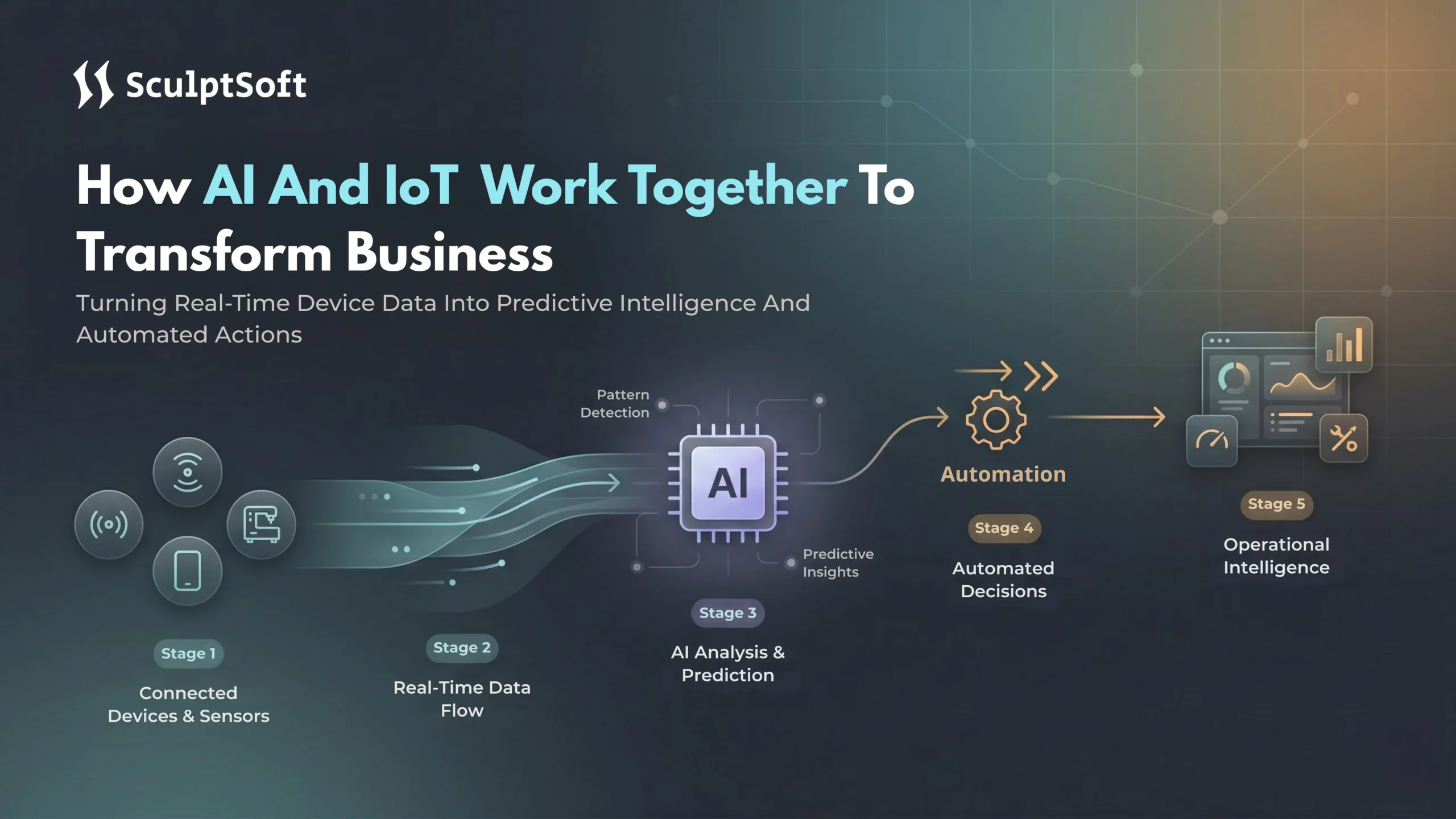
AI and IoT work together by combining real-world data collection with intelligent analysis. IoT devices gather continuous data through sensors and connected hardware. AI processes that data, identifies patterns, makes predictions, and triggers automated actions without waiting for human input.
This combination is what turns raw device data into business decisions.
Here’s how the process works:
1. IoT Sensors Collect Real-World DataConnected devices – on factory floors, in hospitals, across logistics fleets continuously capture inputs like temperature, pressure, location, vibration, and energy consumption. This happens across thousands of endpoints, around the clock.
2. Data Is Transmitted for Processing Collected data moves to a cloud platform or edge computing node depending on how fast a response is needed. Time-critical decisions process at the edge. Less urgent data routes to the cloud for deeper analysis.
3. AI Analyzes the Data in Real Time Machine learning models scan incoming IoT data streams, detect anomalies, identify patterns, and generate predictions in milliseconds. No batch reports. No waiting.
4. The System Acts or AlertsBased on AI analysis, the system either triggers an automated response, rerouting a shipment, flagging a fault, adjusting energy load or sends a prioritized alert to the right person with a clear recommended action.
5. The Model Learns and Improves Every new data point feeds back into the AI model. Over time, predictions get more accurate and the system adapts to changing operational conditions automatically.
That is exactly how AI and IoT work together, not as two separate tools, but as one connected system that collects, learns, and acts in real time.
And once that system is in place, the business benefits of combining AI and IoT from predictive maintenance and cost reduction to real-time decision making and operational efficiency become measurable fast.
6 Business Benefits of Combining AI and IoT
The business benefits of combining AI and IoT go beyond basic automation. When these two technologies work together, they create measurable operational advantages that directly impact revenue, efficiency, and competitive positioning.
1. Predictive Maintenance
Unplanned equipment downtime costs industrial businesses an average of $50 billion annually according to Deloitte. AI-powered IoT sensors continuously monitor equipment health – vibration, temperature, pressure and flag potential failures before they happen. Maintenance teams get ahead of problems instead of reacting to them.
- Reduces unplanned downtime by up to 50%
- Extends equipment lifespan
- Cuts emergency repair costs significantly
2. Real-Time Decision Making
Traditional business decisions rely on reports that are hours or days old. AI IoT integration enables decisions based on what is happening right now across every connected asset, location, and process simultaneously.
- Faster response to operational disruptions
- Automated decisions for routine processes
- Human teams focused on high-value judgment calls only
3. Operational Cost Reduction
AI and IoT work together to eliminate waste across energy consumption, labor, inventory, and maintenance. Systems self-optimize continuously without manual intervention reducing overhead costs that most businesses accept as fixed.
- Smart energy management reduces consumption automatically
- Inventory levels adjust based on real-time demand signals
- Labor is redirected from monitoring tasks to strategic work
4. Enhanced Customer Experience
IoT devices capture real-time customer behavior data. AI analyzes that data to personalize experiences, predict needs, and resolve issues before customers notice them at a scale no human team can match.
- Personalized product and service recommendations
- Proactive issue resolution before customer complaints
- Faster, more accurate service delivery
5. Supply Chain Visibility and Resilience
AI IoT integration gives businesses end-to-end visibility across their supply chain in real time. Disruptions get flagged early, alternative routes get identified automatically, and inventory positions adjust before shortages hit.
- Real-time tracking across every supply chain node
- AI-driven demand forecasting reduces overstock and stockouts
- Faster supplier response to disruption signals
6. Scalable Intelligence Across Operations
Unlike human-dependent processes, AI and IoT systems scale without proportional cost increases. Adding new devices, locations, or data streams doesn’t require hiring more analysts, the system absorbs and processes the additional data automatically.
- One AI model can manage thousands of IoT endpoints
- Insights scale across facilities, geographies, and business units
- Operational intelligence compounds as more data flows in
These six benefits of combining AI and IoT represent where businesses are seeing the clearest and fastest return on investment. But understanding the benefits is one thing and seeing how they play out across specific industries is where the real picture becomes clear.
Real-World Use Cases Across Key Industries
Knowing how AI and IoT work together is one thing. Seeing how it transforms real business operations across industries is what helps business leaders understand where to start and what to expect.
Manufacturing
AI and IoT in manufacturing are turning traditional factories into smart, self-optimizing production environments. IoT sensors on machines and production lines feed real-time data into AI models that monitor performance, detect anomalies, and predict failures before they cause downtime.
- Predictive maintenance reduces unplanned equipment downtime by up to 50%
- AI-powered quality control detects production defects in real time
- Smart energy management cuts facility power costs automatically
- AI continuously analyzes production data to reduce bottlenecks and improve output
For manufacturing businesses, AI and IoT integration means fewer disruptions, lower maintenance costs, and production lines that run smarter with every passing day.
Healthcare
AI and IoT in healthcare replace periodic checkups with continuous, real-time patient monitoring. Connected wearables and medical devices capture patient data around the clock and AI analyzes that data to flag risks before they escalate into emergencies.
- Remote patient monitoring detects early warning signs before clinical deterioration
- IoT asset tracking helps hospital staff locate critical equipment instantly
- AI predicts patient readmission risk using discharge data and vitals
- Connected devices in care settings feed AI systems that support faster clinical decisions
For healthcare organizations, this means fewer adverse events, lower readmission rates, and clinical teams that spend more time on patient care and less time chasing data.
Logistics and Supply Chain
AI and IoT in supply chain management give logistics businesses real-time visibility across every node from supplier to last-mile delivery. Disruptions get flagged early, routes adjust automatically, and inventory positions update in real time.
- GPS and engine IoT sensors feed AI systems that optimize delivery routes and reduce fuel costs
- AI-powered warehouse automation speeds up order fulfillment and reduces labor costs
- Real-time inventory data feeds AI demand forecasting, eliminating overstock and stockouts
- AI identifies supply chain disruptions early giving operators time to reroute before delays hit
For logistics and supply chain businesses, AI and IoT integration means fewer delays, tighter margins protected, and a supply chain that responds to disruptions before they become expensive problems.
Energy and Utilities
AI and IoT in energy management are replacing manual processes with fully automated, self-optimizing grid operations. IoT sensors across infrastructure feed AI systems that balance load, predict failures, and reduce waste continuously.
- AI balances grid load in real time using IoT sensor data reducing outages and energy waste
- Predictive maintenance on pipelines and substations prevents infrastructure failures before they occur
- Smart meters feed AI systems that automatically adjust energy consumption based on demand signals
- AI monitors renewable energy assets and optimizes grid integration in real time
For energy and utilities businesses, AI and IoT working together means lower operational costs, fewer infrastructure failures, and an energy network that adapts to demand automatically.
Retail
AI and IoT in retail help businesses close the gap between what customers want and what is available in real time, across every store and channel. From smart shelves to personalized experiences, the intelligence layer runs continuously behind the scenes.
- IoT shelf sensors detect low stock and trigger automatic replenishment before shelves run empty
- Customer behavior data feeds AI personalization engines improving conversion rates and basket size
- Computer vision and IoT cameras detect theft patterns in real time reducing shrinkage without extra staff
- AI analyzes purchase patterns from connected POS systems to optimize pricing and promotions automatically
For retail businesses, AI and IoT integration means fewer lost sales, better customer experiences, and store operations that run more efficiently without adding headcount.
Across every industry, the pattern is consistent – AI and IoT working together build an intelligence layer that improves operations, reduces costs, and compounds in value over time.
What’s pushing that value even further in 2026 is what the next section covers: edge AI and agentic IoT are changing the speed and scale at which businesses can act on that intelligence.
Edge AI and Agentic IoT - What's Changed in 2026
Most conversations about AI and IoT integration focus on what the technology can do. What’s less discussed is how fast the underlying architecture has shifted and why that shift matters for businesses planning or scaling deployments in 2026.
Two developments are driving that shift: Edge AI and Agentic IoT.
What Is Edge AI in IoT?
Traditionally, IoT devices collected data and sent it to a central cloud server for AI processing. That worked but it created a bottleneck. Cloud roundtrips introduce latency, and in time-critical environments like autonomous vehicles, surgical suites, or live production lines, even a few seconds of delay is unacceptable.
Edge AI solves this by moving AI processing directly onto or close to the IoT device itself.
What this means in practice:
- AI inference happens locally, at the point where data is generated
- Decisions are made in milliseconds without waiting for cloud connectivity
- Sensitive operational data stays on-site reducing security and compliance risk
- Systems continue operating even when internet connectivity is interrupted
For businesses running AI IoT integration across distributed locations like retail stores, manufacturing plants, logistics hubs, edge AI means faster decisions, lower bandwidth costs, and more reliable operations.
What Is Agentic IoT?
Agentic IoT takes AI and IoT integration a step further. Instead of AI simply analyzing data and alerting humans, agentic systems make decisions and execute multi-step actions autonomously without waiting for human approval at each stage.
Think of it as the difference between an AI that tells your maintenance team a machine needs attention and an AI agent that identifies the fault, schedules the maintenance window, orders the replacement part, and updates the production schedule – all automatically.
What agentic IoT looks like across business operations:
- A logistics AI agent detects a delivery delay, identifies an alternative route, notifies the customer, and updates the warehouse in one automated workflow
- A smart building agent detects unusual energy consumption, diagnoses the cause, adjusts HVAC settings, and logs the incident for compliance without human input
- A manufacturing AI agent spots a quality deviation, isolates the affected batch, adjusts production parameters, and alerts the quality team with a full diagnostic report
This is where AI and IoT working together moves from operational efficiency into genuine business transformation.
Why This Matters for Business Leaders in 2026
Edge AI and agentic IoT are not experimental. They are in active production deployment across manufacturing, healthcare, logistics, and energy right now. Businesses that treat AI IoT integration as a future consideration are already behind organizations that have been running these systems for 12 to 18 months.
The key shifts businesses need to plan for:
- Latency is no longer a constraint: Edge AI makes real-time IoT decisions practical at scale
- Human approval bottlenecks are being removed: Agentic IoT handles routine operational decisions end to end
- EU AI Act compliance is live: AI systems operating in IoT environments in Europe must meet transparency and accountability requirements by August 2026
- OT and IT convergence is accelerating: Operational technology and information technology are merging, and AI is the layer connecting them
The businesses pulling ahead in 2026 are not just connecting more devices. They are deploying AI that thinks, decides, and acts across those devices continuously and autonomously.
Common Challenges When Implementing AI and IoT
AI and IoT integration delivers real results but getting there comes with challenges most businesses don’t fully anticipate. Here are the five most common ones and how to address them.
1. Poor Data Quality
Challenge: IoT devices generate massive data volumes but inconsistent, incomplete, or poorly labeled data produces unreliable AI predictions that make decision making worse, not better.
Solution: Standardize data formats across all IoT devices, implement automated data cleaning pipelines, and validate data quality continuously before feeding it into AI models.
2. Legacy System Integration
Challenge: Most enterprises run older operational technology that was never built to connect with modern AI or IoT infrastructure making integration expensive and disruptive.
Solution: Use a phased approach. Connect the highest-value legacy systems first using middleware and API layers without replacing everything at once. Align IT and OT teams under a shared governance structure early.
3. Security and Compliance Risks
Challenge: Every connected IoT device expands the attack surface. Businesses operating under GDPR, HIPAA, or the EU AI Act face additional compliance requirements that apply directly to AI IoT deployments.
Solution: Build security into the architecture from day one, not after deployment. Implement zero trust principles, encrypt data at rest and in transit, and map compliance requirements before any device goes live.
4. Skills Gap
Challenge: AI and IoT integration needs expertise across machine learning, embedded engineering, cloud architecture, cybersecurity, and data operations – all at once. That combination is rare and expensive to hire internally.
Solution: Most businesses move faster by partnering with an AI IoT development company rather than hiring every skill in-house. An experienced AI and IoT consulting partner brings the full skill set ready to go and helps your internal team build knowledge over time.
5. Scaling Beyond the Pilot
Challenge: Many businesses run successful AI IoT pilots but struggle to scale. A system that works across 10 devices in one location behaves very differently across 10,000 devices in 50 locations.
Solution: Scalability needs to be planned from the start, not fixed after the pilot. Work with a custom AI IoT solutions provider who designs for real-world scale from day one so the system grows with your business without breaking down.
These challenges are very common but none of them are impossible to solve. Businesses that partner with the right AIoT implementation company from the start avoid the biggest mistakes and build systems that scale and deliver real ROI.
Why Businesses Choose SculptSoft for AI IoT Development
Most businesses know they need AI and IoT integration, the challenge is finding a partner who builds it around their operations, not around a standard template.
That is what SculptSoft does differently.
We are a custom AI IoT development company with hands-on experience delivering solutions across manufacturing, healthcare, logistics, retail, and more. Every solution we build starts with understanding your business first- your data, your infrastructure, and where AI and IoT will make the biggest difference.
What sets us apart:
- Custom Built: Solutions designed around your specific operations, not adapted from off-the-shelf platforms
- Full Ownership: From IoT integration to AI model deployment and optimization, we handle the entire process end to end
- AWS Partner: As an AWS Partner, we build on secure, scalable cloud infrastructure built for enterprise needs
- Industry Depth: Real delivery experience across the industries that rely on AI and IoT the most.
- Compliance Ready: GDPR, HIPAA, and EU AI Act requirements built in from day one, not added later
Businesses trust SculptSoft because we treat every engagement as a long-term partnership, not a one-time project.
Final Thoughts
Businesses that understand how AI and IoT work together are not just improving operations, they are transforming how their entire business runs.
From predictive maintenance and real-time decision making to autonomous operations powered by edge AI, the impact of AI and IoT integration goes far beyond cost savings. It changes how businesses respond to disruption, serve customers, and compete in their markets.
Every industry covered in this blog – manufacturing, healthcare, logistics, retail, and energy is seeing that transformation happen right now. Not in pilots. Not in roadmaps. In live operations delivering measurable results.
The businesses pulling ahead are the ones that stopped waiting and started building. AI and IoT solutions are proven, the use cases are clear, and the ROI is measurable from day one.
The only question is where your business stands and where you want it to be.
Ready to see how AI and IoT can transform your business operations? SculptSoft builds custom AI and IoT solutions tailored to your industry, your infrastructure, and your goals. Let’s talk about where to start.Talk to Our AI IoT Experts
Frequently Asked Questions
How do AI and IoT work together in business?
AI and IoT work together by combining real-time data collection with intelligent analysis. IoT devices collect data through connected sensors. AI processes that data, detects patterns, and triggers automated actions helping businesses reduce costs, prevent failures, and make faster operational decisions without human intervention.
What is AIoT and why does it matter for business?
AIoT – Artificial Intelligence of Things is what happens when AI and IoT operate as one connected system. IoT collects real-world data. AI analyzes it and acts on it automatically. For businesses, AIoT turns raw operational data into measurable results like lower costs, fewer disruptions, and smarter decisions at scale.
How does AI process data from IoT devices in real time?
AI processes IoT data in real time using machine learning models that continuously scan incoming data streams from connected sensors. The AI detects anomalies, identifies patterns, and generates predictions in milliseconds triggering automated actions or alerts without any manual review required.
How is AI and IoT used in manufacturing and healthcare?
In manufacturing, AI and IoT predict equipment failures before they cause downtime and automate quality control on production lines. In healthcare, connected wearables monitor patient vitals continuously and AI flags early warning signs before they escalate reducing adverse events and hospital readmission rates.
What is edge AI and why does it matter for IoT?
Edge AI runs AI processing directly on or near an IoT device instead of sending data to a cloud server. This eliminates latency, enables millisecond decisions at the point of data generation, reduces security risk, and keeps IoT systems running even without internet connectivity.
How do businesses overcome AI and IoT implementation challenges?
Businesses overcome AI IoT challenges by standardizing data quality before deployment, using phased integration for legacy systems, and building security and compliance requirements into the architecture from day one. Partnering with a specialist AI IoT development company is the fastest way to close the skills gap and scale without costly mistakes.
How does AI IoT integration reduce business costs?
AI IoT integration reduces costs through predictive maintenance that eliminates unplanned downtime, smart energy management that cuts facility costs automatically, and AI-driven inventory control that removes overstock and stockout losses. Businesses across manufacturing, logistics, healthcare, and retail report consistent cost reductions after implementing AI and IoT together.