
AI-Powered E-commerce Analytics and Optimization Platform
About Client
Industry
E-commerce & Retail Technology
Location
USA
Project Overview
Many brands and independent retailers selling on e-commerce marketplaces like Amazon often struggle to monitor performance, track competitors, and identify what truly drives product visibility. Without clear insights into keyword performance, pricing trends, and customer sentiment, sellers rely heavily on trial and error leading to missed opportunities and slow sales growth.
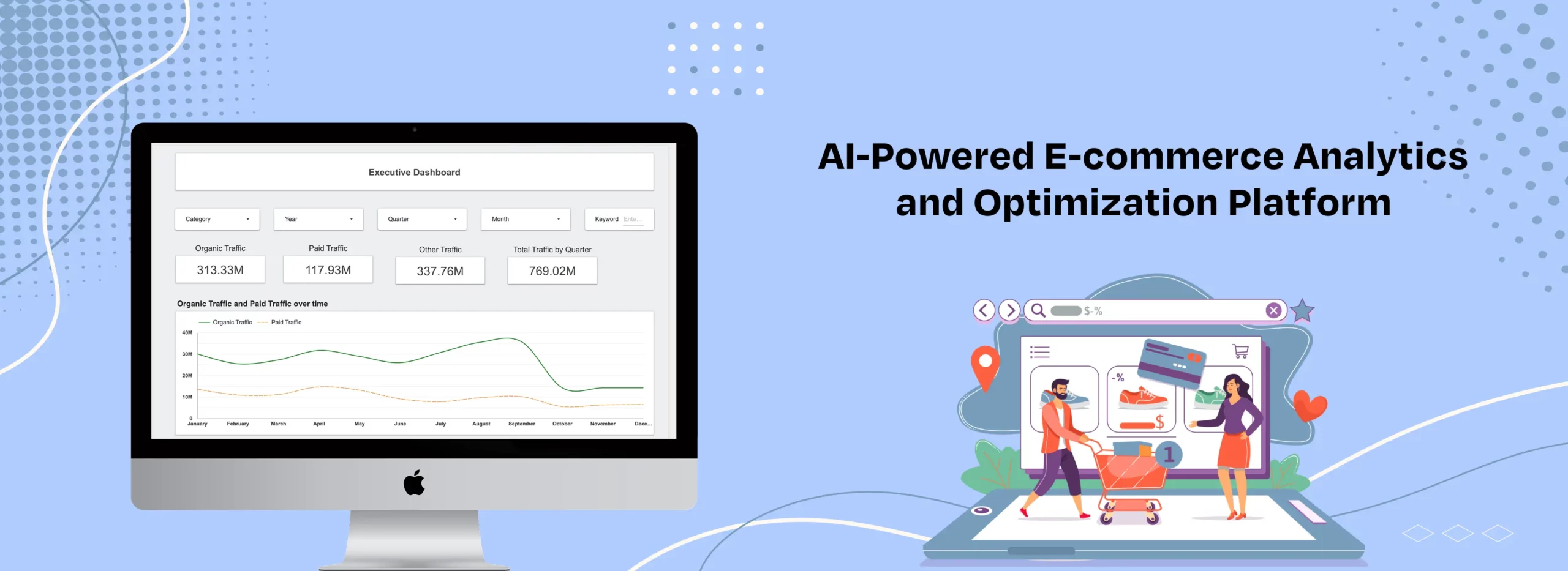
To address these challenges, SculptSoft developed an AI-Powered E-commerce Analytics and Optimization Platform that equips Amazon vendors and sellers with intelligent insights to boost product visibility and sales performance. The system automatically collects and analyzes real-time product data from subscribed seller accounts, transforming it into intuitive dashboards and AI-generated recommendations that drive smarter, faster decisions.
The platform provides keyword optimization insights, pricing strategy adjustments, listing improvement suggestions, competitor benchmarking, and predictive sales forecasting. It also analyzes customer reviews and sentiment to highlight improvement areas, recommends advertising optimizations for sponsored campaigns, and tracks the ROI of marketing efforts.
Additional capabilities include real-time alerts on ranking changes, automated keyword tracking, customizable performance reports, and inventory-level forecasting to help sellers plan proactively. By combining analytics, automation, and AI intelligence, the solution enables sellers to refine their product strategy, maintain competitive positioning, and achieve consistent sales growth through data-driven decision-making.
Traditional Process
Before implementing the AI-Powered E-commerce Analytics and Optimization Platform, Amazon vendors and sellers relied heavily on manual processes and fragmented tools to monitor their store performance. They spent significant time collecting data, analyzing competitors, and testing strategies without a unified view of results – often making decisions based on incomplete information.
Here’s how the traditional process typically worked:
01
Manual Data Monitoring
Sellers had to log into Amazon’s central vendor or seller portals daily to check product listings, sales, and ranking data manually.
02
Scattered Insights
Sales, keyword, and performance data were available across multiple dashboards and spreadsheets, offering no unified, comparative analysis.
03
Guess-Based Keyword Strategy
Product keywords were selected manually without understanding search intent, competition levels, or trending terms – resulting in poor visibility in search results.
04
Manual Competitor Tracking
Sellers had to manually identify who their competitors were and analyze their listings, pricing, and marketing strategies without automation or benchmarking tools.
05
Reactive Decision-Making
Sales and ranking strategies were often developed reactively based on short-term trends rather than predictive analytics or long-term insights.
06
Disjointed Pricing and Promotion Adjustments
Pricing changes, discounts, and campaigns were executed without clear data on their impact on conversions or ranking.
07
Limited Customer Sentiment Analysis
Sellers manually read and categorized reviews to identify product or service issues, making it difficult to spot recurring patterns quickly.
08
No Automated Alerts or Forecasting
There were no proactive notifications for ranking drops, competitor movements, or performance anomalies – sellers discovered problems only after sales had declined.
Challenges Faced
The manual, disconnected workflow made it increasingly difficult for vendors and sellers to scale, compete, and maintain consistent sales performance. Without automation and unified insights, they faced several recurring challenges that limited visibility and growth:
01
Lack of Unified Data Visibility
Product, keyword, and competitor data were scattered across multiple dashboards and spreadsheets, making it hard to get a complete performance picture.
02
Time-Consuming Manual Analysis
Sellers spent hours collecting, comparing, and interpreting data from Amazon’s central portals – leaving little time for actual strategy or optimization.
03
No Predictive Insights or Automation
There were no tools to automatically identify ranking trends, forecast demand, or alert sellers to potential performance drops.
04
Inaccurate Keyword Targeting
Without real-time keyword analytics, sellers struggled to identify high-performing search terms, resulting in poor visibility and missed ranking opportunities.
05
Limited Competitor Intelligence
Sellers manually tracked competitor listings, pricing, and promotions with no automated benchmarking, making it difficult to respond to market changes quickly.
06
Unstructured Pricing Strategy
Price adjustments were based on assumptions, with no insight into how they affected conversion rates, margins, or competitive positioning.
07
Low Sales and Profit Margins
Despite continuous efforts, sellers often failed to achieve profitable sales due to poor keyword strategy, weak visibility, and ineffective pricing or campaign decisions.
08
Delayed Decision-Making
The lack of centralized analytics and alerts meant that sellers identified performance issues only after they impacted sales.
09
Inefficient Ad Campaign Optimization
Marketing budgets were often spent on underperforming keywords and campaigns due to the absence of ROI tracking and AI-driven recommendations.
Our Solution - AI-Powered E-commerce Analytics and Optimization Platform
To overcome these challenges, SculptSoft designed and implemented an AI-Powered E-commerce Analytics and Optimization Platform, an intelligent data-driven system that empowers Amazon vendors and sellers to make informed business decisions. The platform was built to automate data collection, centralize insights, and deliver AI-generated recommendations that directly improve product visibility, search ranking, and profitability.
Key elements of SculptSoft’s solution included:
01
Automated Data Aggregation
The system continuously collects both Amazon’s public data and subscriber-specific data (at ASIN and keyword levels) into a secure, scalable data warehouse.
02
Advanced Data Transformation
Raw marketplace data is cleaned, categorized, and transformed into meaningful models, enabling powerful analytical and predictive insights.
03
E-commerce Performance Metrics
Calculates essential metrics such as Share of Voice, Click Share, and Volume Curves to help sellers track visibility, competitiveness, and sales trends.
04
AI-Powered Recommendations (LLMs)
Leveraging Large Language Models, the platform analyzes large data sets to suggest keyword improvements, pricing strategies, campaign optimization, and content enhancements for better sales performance.
05
Competitor Benchmarking & Market Intelligence
Provides detailed competitor comparisons, identifying gaps and opportunities to improve positioning and gain a competitive edge.
06
Real-Time Dashboards & Analytics
Interactive dashboards visualize product rankings, keyword performance, campaign ROI, and profitability in real time.
07
Alerts & Performance Notifications
Automated alerts notify sellers about ranking changes, performance drops, or competitor activity to enable proactive responses.
08
Predictive Forecasting
AI-driven forecasting models predict future sales trends, demand spikes, and seasonal variations to support smarter inventory and pricing decisions.
09
Automated Reporting
Customizable reports summarize performance insights, helping teams align marketing, pricing, and inventory strategies efficiently.
By integrating data engineering, AI analytics, and automation, SculptSoft delivered a platform that replaced manual guesswork with intelligent decision-making – helping sellers consistently improve visibility, optimize campaigns, and maximize profitability.
Outcome
By implementing the AI-Powered E-commerce Analytics and Optimization Platform, the client transformed its manual, reactive sales process into a data-driven, intelligent operation. The solution delivered measurable improvements in performance, visibility, and profitability:
Features
Centralized Product & Keyword Insights
Competitor Comparison & Improvement Suggestions
AI Chat Assistant for On-Demand Data Insights
Automated Data Collection at ASIN (Amazon Standard Identification Number) Level
AI-Driven Keyword & Listing Optimization
Pricing & Profitability Recommendations
Multi-Account Vendor & Seller Management
Scalable Data Warehouse Architecture
Ad Campaign Optimization & ROI Tracking
Share of Voice, Click Share & Volume Curve Analytics
Customer Sentiment & Review Analysis
Role-Based Access & Secure Data Management
Sales Forecasting & Demand Prediction
Performance Alerts & Notifications
Customizable Dashboards & Reports
Technologies Used

Cloud
- AWS Redshift
- Amazon Managed Workflows for Apache Airflow (MWAA)
- AWS ECS

Front-end
- ReactJS

Backend
- FastAPI
- Langchain