Introduction
Enterprise AI budgets are growing faster than ever. So is the pressure to prove those investments actually deliver in production, not just in a proof of concept.
For business leaders evaluating or scaling AI systems in 2026, the most consequential architectural decision isn’t which large language model to deploy or which AI vendor to partner with. It’s a more fundamental question – one that directly determines how accurate, scalable, compliant, and cost-effective your enterprise AI will be over the next three to five years.
RAG vs fine-tuning. RAG (Retrieval-Augmented Generation) connects your AI to a live knowledge base at query time, keeping responses current without retraining the model. Fine-tuning retrains a foundation model on your specific data so it internalises your domain terminology, tone, and output format at a parameter level.
Most enterprise AI projects that stall, overspend, or underdeliver in production trace the root cause back to this single decision made too quickly or without the right context. Choosing the wrong approach creates AI technical debt that compounds every quarter, limits your vendor options, and makes ROI harder to justify as board expectations grow.
In 2026, with hybrid AI architectures becoming the production standard, getting this decision right has never mattered more. Here is exactly how the two approaches differ, when to use each, and when to combine them.
What Is the Difference Between RAG and Fine-Tuning?
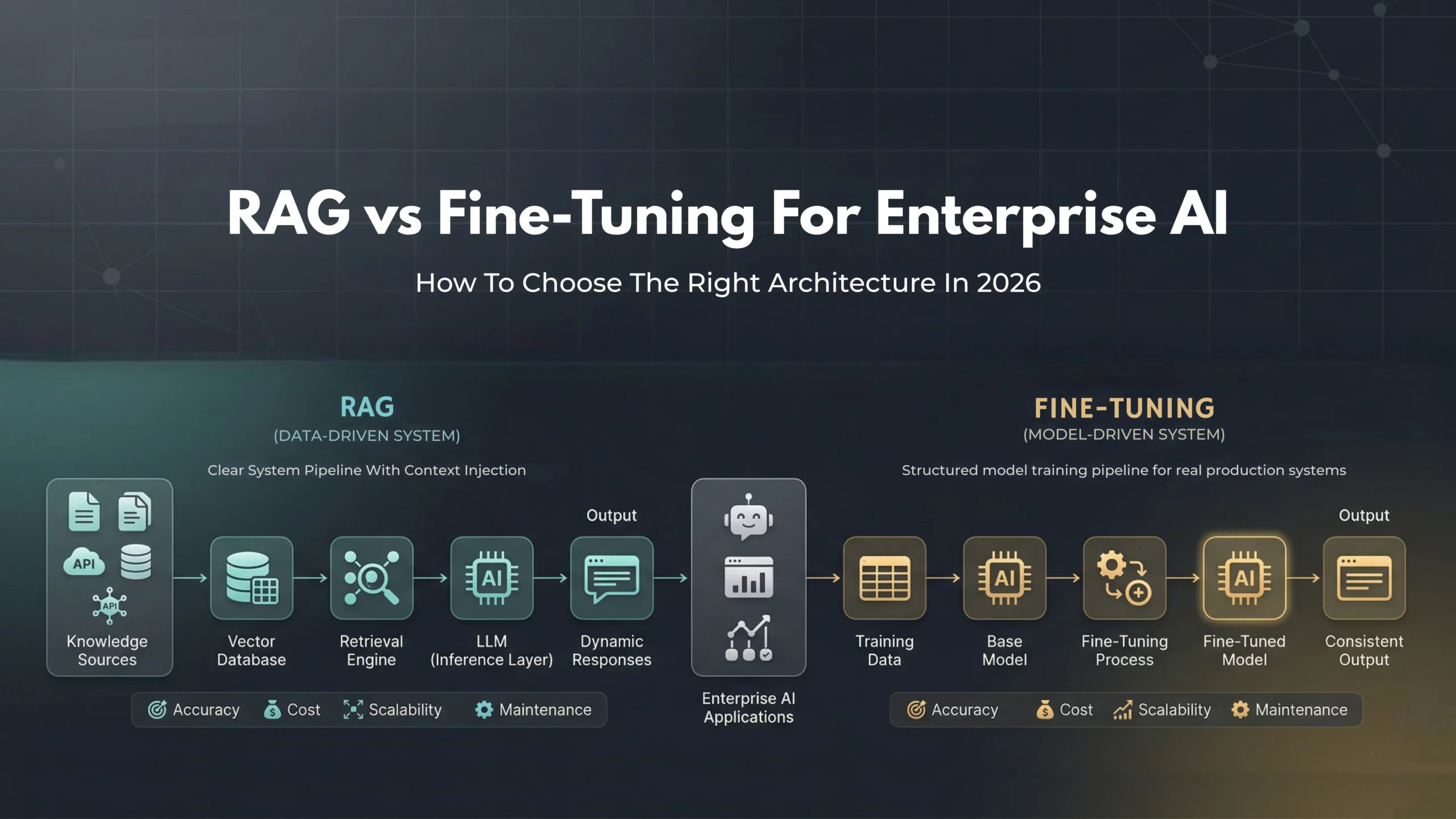
RAG and fine-tuning both customize AI for your business but they solve completely different problems. The clearest way to understand the difference: RAG controls what your AI knows. Fine-tuning controls how your AI behaves.
RAG - Knowledge Layer
RAG connects your large language model to an external knowledge base at runtime. It retrieves relevant content from your documents, databases, or internal records and feeds it into the model before generating a response. The model itself never changes. Update your knowledge base and your AI reflects it immediately, no retraining, no MLOps overhead, no downtime.
Fine-Tuning - Behaviour Layer
Fine-tuning retrains a foundation model on your specific dataset. The model internalises your domain terminology, output formats, reasoning patterns, and communication style at a parameter level. What it learns is powerful but frozen at training time. When your data or requirements change, you retrain.
RAG vs. Fine-Tuning: At a Glance
| Dimension | RAG | Fine-Tuning |
|---|---|---|
| What it changes | Knowledge – what the model retrieves | Behaviour – how the model responds |
| Knowledge freshness | Real-time updateable | Frozen at training time |
| Hallucination risk | Lower – grounded in source documents | Higher on facts; consistent on format |
| Compliance and auditability | Strong – every answer traceable | Reasoning lives inside model weights |
| Vendor portability | High – swap LLM, keep your data layer | Low – weights tied to model and provider |
| Time to production | Weeks | Several months |
| Cost profile (2026) | Lower upfront; higher at scale | Higher upfront; lower per-query at volume |
Dimension
What it changes
RAG
Knowledge – what the model retrieves
Fine-Tuning
Behaviour – how the model responds
Dimension
Knowledge freshness
RAG
Real-time updateable
Fine-Tuning
Frozen at training time
Dimension
Hallucination risk
RAG
Lower – grounded in source documents
Fine-Tuning
Higher on facts; consistent on format
Dimension
Compliance and auditability
RAG
Strong – every answer traceable
Fine-Tuning
Reasoning lives inside model weights
Dimension
Vendor portability
RAG
High – swap LLM, keep your data layer
Fine-Tuning
Low – weights tied to model and provider
Dimension
Time to production
RAG
Weeks
Fine-Tuning
Several months
Dimension
Cost profile (2026)
RAG
Lower upfront; higher at scale
Fine-Tuning
Higher upfront; lower per-query at volume
Understanding the knowledge-vs-behaviour distinction is what separates enterprise AI teams that get this right from those that don’t. Knowing the difference is half the decision. The other half is knowing where most enterprise teams go wrong when applying both.
What Are the Most Common RAG and Fine-Tuning Mistakes in Enterprise AI?
Enterprise AI failures rarely come from choosing the wrong vendor. They come from making the wrong architectural decision early and not recognising it until the damage is done. These are the four mistakes that consistently appear in stalled or over-budget enterprise AI deployments.
Mistake 1: AI Hallucination Risk
Both RAG and fine-tuning carry hallucination risk, but for different reasons. Fine-tuned models hallucinate when asked about anything outside their training data. RAG systems hallucinate when retrieved documents are outdated, poorly structured, or irrelevant. Either way, a hallucinating AI in a customer-facing or compliance-critical environment is a direct business liability.
The fix: With RAG, invest in data quality and retrieval accuracy before deployment. With fine-tuning, define clear scope boundaries for what the model should and should not answer then test against those boundaries rigorously before going live.
Mistake 2: Poor Enterprise Data Quality
Teams spend months choosing between RAG and fine-tuning while their underlying enterprise data is unstructured, outdated, and inconsistent. The architecture cannot fix bad data, it amplifies it. This is the most underestimated risk in enterprise AI deployments.
The fix: Audit and clean your enterprise data before making any architecture decision. The quality of your AI output is a direct reflection of the quality of data behind it.
Mistake 3: Fine-Tuning for Knowledge Problems
When an enterprise needs its AI to answer questions from current internal documents like policies, compliance guidelines, product data, fine-tuning feels like the thorough option. But fine-tuning freezes knowledge at training time. By the time the model deploys, it is already outdated. The business has spent months and significant budget solving the wrong problem.
The fix: If your data changes frequently, RAG is the right call. Connect your AI to a live knowledge base and your AI reflects updates immediately, without retraining cycles or downtime.
Mistake 4: RAG vs Fine-Tuning as Competitors
Most enterprise AI failures are not caused by choosing the wrong approach. They are caused by assuming only one approach is needed. RAG handles knowledge. Fine-tuning handles behaviour. Most production-grade enterprise AI systems in 2026 use both.
These mistakes are avoidable when the architecture decision is tied to a clear business outcome from the start. Knowing exactly when RAG or fine-tuning is the right call makes all the difference.
When Should an Enterprise Use RAG?
RAG is the right choice when your enterprise needs accurate, current, and traceable AI responses without retraining your model every time your data changes. For most enterprise AI deployments in 2026, RAG is the correct default starting point.
1. When Your Enterprise Data Changes Often
If your business data updates regularly, such as compliance policies, pricing documents, product catalogs, regulatory guidelines, RAG is the only practical architecture.
- Update your knowledge base and the AI reflects it immediately
- No retraining cycles, no downtime, no stale outputs
- Ideal for fast-moving industries like financial services, healthcare, and retail
2. RAG for Compliance and Regulatory AI
In regulated industries, every AI output needs to be traceable to a verified source. RAG provides built-in citation and source attribution that fine-tuning cannot match.
- Every response links back to the exact source document
- Supports audit trails for internal review and external regulators
- Critical for healthcare AI, financial services AI, and legal document management
3. RAG for Enterprise Knowledge Management
When employees need instant answers from internal documentation – HR policies, technical runbooks, contracts, product manuals, RAG turns your existing knowledge base into an AI-powered intelligence layer.
- Eliminates time lost searching through siloed documents and folders
- Serves multiple departments from one unified retrieval architecture
- Scales as your enterprise data grows without additional retraining
4. RAG for Customer Support Automation
RAG-powered AI answers customer questions accurately from live product documentation and policy files and gives sales teams instant access to the right information during live calls.
- Reduces ticket resolution time significantly
- Ensures responses are always based on current product and policy data
- Works across both customer-facing and internal AI applications
5. RAG Implementation Without ML Expertise
RAG does not require a dedicated MLOps team or months of training data preparation. Teams with existing data engineering skills can deploy in weeks.
- Faster time to production compared to fine-tuning
- Lower upfront investment and easier to justify ROI
- Update the knowledge base, not the model simpler to maintain long term
In 2026, RAG is the default starting point for most enterprise AI deployments particularly where data freshness, regulatory compliance, and speed to production are priorities.
When Should an Enterprise Use Fine-Tuning Instead of RAG?
Fine-tuning is the right choice when your enterprise needs consistent AI behaviour, specific tone, output format, domain reasoning, or task performance that cannot be achieved through retrieval alone. Fine-tuning is not the default starting point, but when behaviour consistency, low latency, or offline deployment are non-negotiable, it is the right tool.
1. Fine-Tuning for Domain-Specific AI Behaviour
When your AI needs to consistently reflect your industry’s terminology, reasoning patterns, or communication style, fine-tuning embeds that behaviour directly into the model at a parameter level.
- Internalises domain-specific language – legal, medical, financial, technical
- Delivers consistent outputs without lengthy system prompts on every query
- Ideal when your use case requires deep specialisation, not just information retrieval
2. Fine-Tuning for Brand Voice and Tone Consistency
Generic LLMs do not naturally reflect your brand voice. Fine-tuning trains the model on your preferred communication style so every output customer-facing or internal sounds consistent and on-brand.
- Eliminates inconsistent or off-brand AI responses in production
- Reduces reliance on complex prompt engineering to enforce tone
- Critical for enterprises where brand consistency directly impacts customer trust
3. Fine-Tuning for Structured Output and Classification
For tasks that require predictable, structured outputs – document routing, sentiment classification, data extraction, report generation, fine-tuning delivers higher accuracy and reliability than RAG.
- Produces consistent formatting across high-volume repetitive tasks
- Outperforms general-purpose models on narrow, well-defined workflows
- Reduces errors in classification-heavy enterprise AI applications
4. Fine-Tuning for Low Latency AI Applications
Fine-tuned models do not require a retrieval step before generating a response. For high-volume, real-time applications where speed is critical, fine-tuning delivers lower latency than RAG.
- Sub-second response times for customer-facing AI at scale
- No retrieval overhead – faster inference for repetitive, predictable queries
- Better suited for applications where response speed directly impacts user experience
5. Fine-Tuning for Offline and On-Device AI
When enterprise deployments cannot rely on external databases or cloud connectivity such as edge devices, secure environments, offline operations, fine-tuning embeds all required knowledge directly into the model.
- Operates without internet access or external knowledge base
- Suitable for secure, air-gapped, or on-premise enterprise environments
- Eliminates dependency on retrieval infrastructure for stable, closed domains
Fine-tuning is not the default starting point but when behaviour consistency, low latency, or offline deployment are non-negotiable, it is the right tool for the requirement.
Should Enterprises Use RAG and Fine-Tuning Together?
Yes and for most serious enterprise AI deployments in 2026, they should. The most capable enterprise AI systems are not built on RAG alone or fine-tuning alone. They use both, each handling the layer it was designed for. This is not a complex architectural decision. It is a practical division of responsibility.
RAG handles knowledge. Fine-tuning handles behaviour.
Fine-tune your model on your domain terminology, communication style, and output format. It learns how to respond consistently, on-brand, and structured correctly every time. Then layer RAG on top to retrieve current, verified information from your knowledge base at query time. Every response is grounded in the right facts, from the right source, at the right moment.
The result is an enterprise AI system that is both accurate and consistent, something neither approach delivers reliably on its own.
How Does a Hybrid RAG and Fine-Tuning Architecture Work in Production?
The hybrid pattern is already in production across enterprise verticals in 2026:
- Healthcare AI: Fine-tuned for clinical terminology and compliance standards; RAG retrieves current treatment guidelines and patient-specific data
- Financial Services AI: Fine-tuned for regulatory tone and structured reporting; RAG retrieves real-time market data and policy documents
- Legal AI: Fine-tuned for legal reasoning and document structure; RAG retrieves current case law and client-specific information
- Enterprise Customer Support: Fine-tuned for brand voice and resolution workflows; RAG retrieves current product documentation and policy files
In 2026, this hybrid architecture is also increasingly embedded within Agentic AI systems where the AI model decides autonomously when to retrieve, what to retrieve, and when to stop. The distinction between RAG and fine-tuning becomes more fluid in agentic contexts, which is exactly why getting the foundational architecture right matters more as enterprises move toward autonomous AI workflows
How Does Hybrid Architecture Protect Enterprises from Vendor Lock-In?
One strategic advantage most enterprises overlook when designing hybrid AI architecture is long-term flexibility. When your RAG layer is built on open retrieval infrastructure, your data stays portable. When your fine-tuned model is built on an open or swappable base model, you can upgrade as better models emerge without rebuilding your entire AI stack.
No single vendor controls your enterprise AI system. That flexibility compounds in value every year as AI technology evolves and your business requirements change. RAG keeps your enterprise AI truthful today. Fine-tuning keeps it consistent tomorrow.
RAG vs. Fine-Tuning: How to Choose the Right Architecture for Your Enterprise
- Does your data change frequently weekly, monthly, or in real time?
- Do you need every AI response traceable to a verified source?
- Is the problem about what your AI knows or how it responds?
- Do you need to go live in weeks rather than months?
- Is consistent brand voice or output format non-negotiable?
If most answers point in one direction, your architecture choice is already made.
RAG vs. Fine-Tuning Decision Framework
| Business Requirement | RAG | Fine-Tuning | Both |
|---|---|---|---|
| Data changes frequently | ✓ | ||
| Compliance and audit trail required | ✓ | ||
| Need to deploy quickly | ✓ | ||
| Consistent tone and brand voice needed | ✓ | ||
| Structured output or classification tasks | ✓ | ||
| Low latency at high query volume | ✓ | ||
| Knowledge freshness AND behaviour consistency | ✓ | ||
| Regulated industry with domain-specific outputs | ✓ | ||
| Enterprise-scale production AI | ✓ |
Start With RAG. Add Fine-Tuning When Needed.
For most enterprise AI deployments, RAG is the right starting point. It is faster to deploy, easier to govern, and delivers measurable value without requiring a dedicated ML team or months of training data preparation.
Fine-tuning becomes the right addition when RAG is already working and behaviour consistency, tone, or structured output quality is still falling short of production requirements.
Choosing both from day one only makes sense when your use case genuinely requires real-time knowledge access and consistent behavioural outputs which is increasingly common in regulated industries like healthcare, financial services, and legal.
The architecture that wins in enterprise AI production is not the most complex one. It is the one that solves your specific business problem and stays flexible enough to evolve as your requirements grow.
How SculptSoft Builds Enterprise AI Without Vendor Lock-In
As an AWS Partner specialising in custom AI development, we design enterprise AI systems that give business leaders full control over their data, their model choices, and their long-term AI roadmap. No platform dependency. No lock-in. No rebuilding from scratch every time requirements change.
What we deliver:
- Custom RAG development: knowledge-grounded AI built on your enterprise data
- LLM fine-tuning services: domain-specific behaviour, tone, and structured output
- Hybrid RAG + fine-tuning architecture for enterprises that need both
- Enterprise AI consulting: architecture assessment before any build begins
- Data engineering and AI pipeline infrastructure: clean data foundations for production AI
We have deployed enterprise AI solutions across healthcare, financial services, manufacturing, and retail – industries where compliance, auditability, and scalability are non-negotiable.
Ready to move from pilot to production? Connect with SculptSoft at info@sculptsoft.com
Final Thoughts: What Enterprise Leaders Should Decide in 2026
The RAG vs fine-tuning question is no longer a binary choice. Enterprise AI teams succeeding in production in 2026 are asking a more precise question: which problem am I actually solving, and which architecture fits that problem?
- If the problem is knowledge, keeping your AI accurate, current, and traceable – RAG is the answer
- If the problem is behaviour, consistent tone, structured outputs, domain-specific reasoning – fine-tuning is the answer
- If the problem is both which it is for most serious enterprise AI deployments – the hybrid architecture is the answer
The enterprises that get this right share one thing in common. They tied their architecture decision to a specific business outcome before writing a single line of code. They chose flexibility over convenience. And they built systems designed to scale, not just to demo well.
The wrong architecture creates AI technical debt that compounds every quarter, limits vendor options, and makes AI ROI harder to justify as board expectations grow. Getting this decision right is not a technical challenge. It is a strategic one.
Frequently Asked Questions
What is the difference between RAG and fine-tuning in enterprise AI?
RAG connects a language model to an external knowledge base at runtime so responses stay current without retraining. Fine-tuning retrains the model on your specific data to change how it responds and behaves. RAG controls what the model knows. Fine-tuning controls how it acts. Most production enterprise AI systems in 2026 use both.
Is RAG better than fine-tuning for enterprise AI?
RAG is the better starting point for most enterprise AI deployments. It is faster to deploy, easier to govern, and works without a dedicated ML team. Fine-tuning delivers stronger results for behaviour consistency and domain-specific outputs. Start with RAG and add fine-tuning when behaviour quality falls short of production requirements.
Can you use RAG and fine-tuning together?
Yes and for most enterprise AI deployments, you should. Fine-tune for consistent behaviour and tone. Layer RAG on top for real-time knowledge retrieval. This hybrid architecture delivers accuracy and consistency that neither approach achieves alone. It is the production standard in regulated industries in 2026.
Does RAG reduce AI hallucinations in enterprise applications?
Yes. RAG reduces hallucinations by grounding responses in retrieved source documents rather than the model’s internal knowledge. However, if the knowledge base contains outdated or poorly structured data, hallucination risk remains regardless of architecture. Data quality is the single most important factor in any RAG deployment.
How much does enterprise RAG implementation cost compared to fine-tuning?
RAG has lower upfront costs and faster time to production, making it cheaper in the first year for most deployments. Fine-tuning carries higher upfront training investment but reduces per-query costs at high volume over time. The right cost model depends on query volume and how frequently your underlying data changes.
How does RAG support compliance in regulated industries like healthcare and financial services?
RAG provides source attribution on every AI response linking each output back to the exact source document. This supports audit trails required under HIPAA, SOX, GDPR, and the EU AI Act. Fine-tuning alone cannot provide this level of traceability, making RAG essential for compliance-critical enterprise AI.