Introduction
Your AI Agents are already working. Right now, they are accessing databases, executing transactions, and making decisions that affect real business operations. The question is not whether they are productive. The question is whether your security team has any real visibility into what they are doing.
Most enterprises do not. They have taken their existing human-user security model and applied it to AI agents without changing anything. That mismatch is the root cause of most AI security failures, and the industry is only beginning to feel the consequences. According to Gartner, by 2028, 25% of enterprise breaches will be traced back to AI agent abuse, from both external and malicious internal actors.
For businesses that have already deployed agentic AI, or are actively evaluating it, the security architecture decision cannot wait until after deployment. Retrofitting controls post-breach costs far more than implementing them at build time.
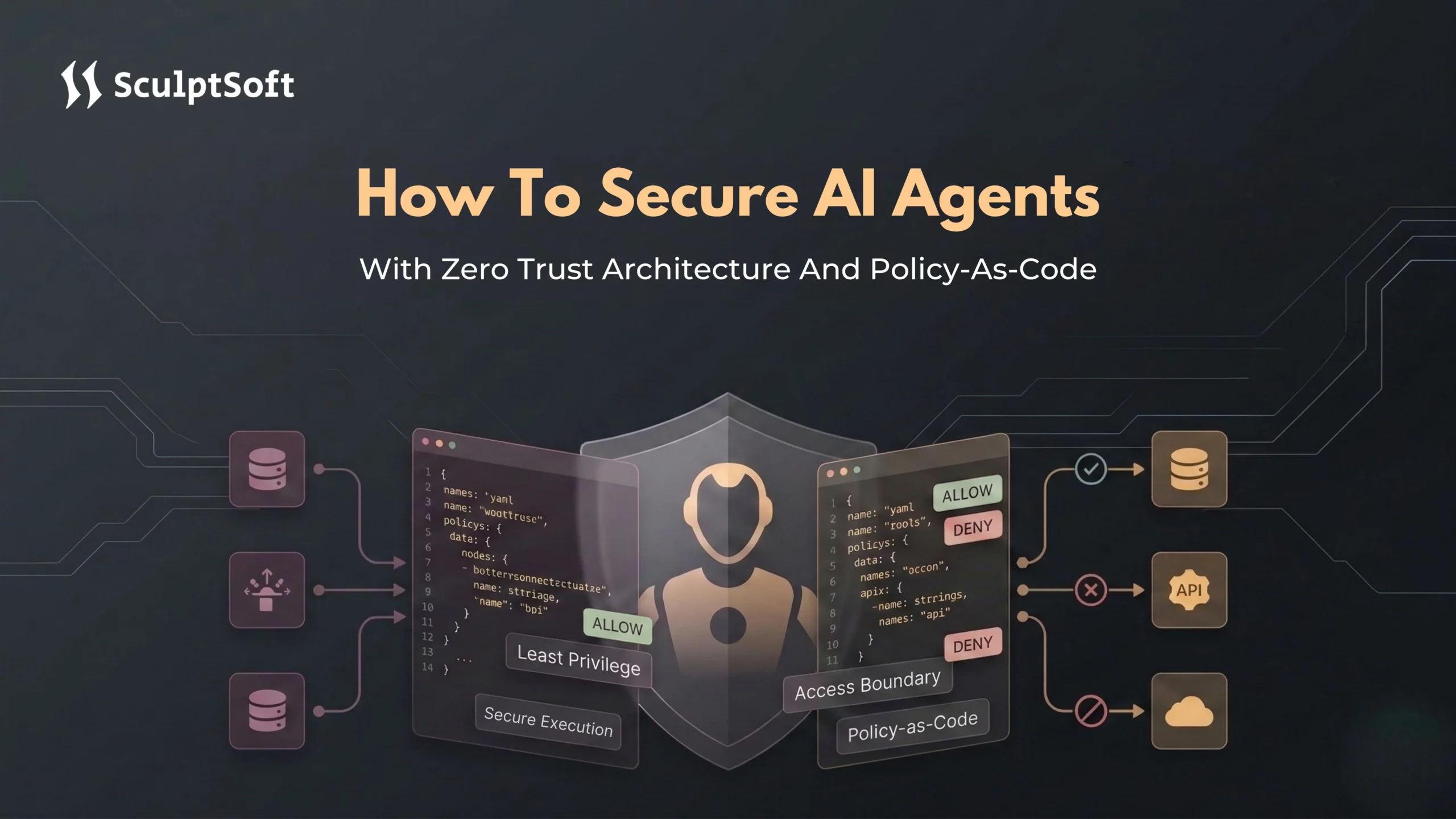
This guide covers the complete picture: why traditional security models fail AI agents, how Zero Trust architecture and Policy-as-Code work together to fix that, and the step-by-step framework your team can follow to implement it without slowing down deployment.
Why Do Traditional Security Models Fail to Protect Autonomous AI Agents?
What Makes AI Agent Behavior Different from Human User Behavior?
Every traditional security system was built around one core assumption: the entity requesting access is a human. Humans log in at predictable hours, work through familiar workflows, and operate at speeds a security system can monitor comfortably. AI agents break every one of those assumptions.
- They never log out. Agents run around the clock, making access requests in milliseconds across multiple systems at once.
- They adapt in real time. Unlike humans, agents adjust their behavior based on live data in ways that static policy rules were never designed to anticipate.
- They move laterally. A single agent workflow can traverse APIs, databases, cloud services, and third-party integrations within seconds.
- They create emergent behavior. In multi-agent environments, agents develop coordination patterns that no one explicitly programmed, and that no one is actively watching.
Traditional security grants broad access on first authentication and then assumes ongoing trust. With AI agents, that assumption is a structural liability, not a policy gap.
What Security Vulnerabilities Do Conventional AI Systems Create?
When you apply a human-user security model to AI agents, four specific vulnerabilities appear almost immediately:
Development teams grant broader permissions than any task requires, to avoid access errors during testing. That access rarely gets reduced after go-live.
A legitimate agent executing a manipulated instruction looks identical to normal operations. The security system sees an authorized request. It cannot see that the instruction was injected.
Session-based auth validates the agent at startup. It does not detect prompt injection or behavioral drift that happens an hour after deployment.
Traditional monitoring has no visibility into the context of interactions between agents, creating openings for cascade failures or coordinated unauthorized actions.
What Does an AI Agent Security Breach Actually Cost an Enterprise?
The cost of a breach extends well beyond the immediate incident. IBM’s 2024 research found the average data breach now costs $4.88 million. For autonomous AI agent failures, four dimensions of damage compound quickly:
- Financial losses: A compromised trading agent can execute unauthorized transactions worth millions before detection. An overprivileged data agent can exfiltrate sensitive records in seconds.
- Regulatory penalties: Security gaps in AI systems handling protected data trigger enforcement under GDPR, HIPAA, and the EU AI Act.
- Operational disruption: Containing a breach often requires shutting down entire autonomous workflows that the business now depends on.
- Reputational damage: Enterprise clients treat AI security failures as evidence of broader governance failure, not just a technical incident, affecting future procurement and partnerships.
What Is Zero Trust Security for AI Agents, and How Does It Work?
Zero Trust for AI agents is a security model that never assumes an agent is safe, even after it has already been verified. Every action requires real-time authentication and authorization, access is limited to exactly what the task needs at that moment, and every behavior is continuously monitored against known baselines.
What Are the Core Principles of Zero Trust for AI Systems?
For businesses looking to understand how to secure AI Agents with Zero Trust, six core principles define the framework:
Every operation requires real-time authentication and authorization. An agent that accessed a database five seconds ago must re-authenticate before accessing it again. No inherited sessions.
Agents receive only the minimum permissions required for the specific task at that moment. Access is granted when needed and revoked immediately when the task is complete.
Design the architecture assuming that any agent may be compromised right now. Every interaction is monitored, logged, and analyzed for signs of manipulation or drift.
Agents operate inside isolated environments with tightly controlled communication pathways. Moving between segments requires explicit, verified authorization, not network proximity.
Access decisions consider the full context: which agent, which resource, what time, from where, and under what conditions. The same action can be permitted in one context and blocked in another.
Security is not a gate at entry. Every action throughout an agent’s entire operation is monitored against behavioral baselines, with anomalies flagged before damage occurs.
What Are the Key Components Every Zero Trust AI Architecture Needs?
Implementing Zero Trust for autonomous AI Agents requires six interconnected components. Each addresses a distinct failure mode in conventional enterprise AI security frameworks:
- Identity and Access Management (IAM): Every agent gets a unique, cryptographically verifiable identity using short-lived tokens that expire within minutes. No shared credentials, no standing access.
- Policy Decision Point (PDP): A centralized engine evaluates every access request in real time against current policies, agent context, and threat intelligence before any action is permitted.
- Policy Enforcement Point (PEP): Distributed components intercept agent actions before execution and enforce PDP decisions at the point of action, not at a network perimeter.
- Continuous Monitoring and Behavioral Analytics: Real-time analysis compares agent behavior against established baselines. Deviations are flagged immediately.
- Automated Response Systems: When violations are detected, automated systems revoke access, isolate the affected agent, or initiate human review without waiting for manual intervention. At machine speed, waiting for a human is too slow.
- Immutable Audit Logging: Every agent action, access decision, and policy evaluation is recorded in tamper-proof logs that support forensic investigation and regulatory compliance.
This is the foundation. Implementing it manually at enterprise scale is where most organizations get stuck, which is exactly why Policy-as-Code is the layer that makes Zero Trust operationally viable.
What Is Policy-as-Code, and Why Is It Essential for AI Agent Security?
Policy-as-Code transforms security rules from documents and manual configurations into version-controlled, automatically tested, and continuously enforced software. Security policies execute at the same speed as your AI agents, not days later after a human reviews a ticket.
What Is Policy-as-Code for AI Security?
Instead of managing spreadsheets of access rules or relying on a human to configure permissions for each new agent deployment, security policies are written in declarative code. The most common tool for this is Open Policy Agent (OPA), which uses a language called Rego to define exactly what any agent is and is not allowed to do.
For business leaders evaluating how to implement Zero Trust for autonomous AI Agents, Policy-as-Code is the mechanism that makes the framework operationally viable at scale. Four properties make it essential:
- Real-time enforcement: Policies execute in milliseconds, matching the operational speed of AI Agents rather than lagging behind it. Manual enforcement at this speed is not possible.
- Consistency at scale: The same policy applies uniformly across every agent in your infrastructure. There is no configuration drift, no manual error, no agent that falls through a gap in your enterprise AI security framework.
- Version control and auditability: Every policy change is logged with a timestamp, author, and rollback capability. A compliance audit becomes a code review, not a manual records exercise.
- Pre-deployment testing: Like application code, policies are validated in staging environments before reaching production. Security vulnerabilities are caught before deployment, not after a breach.
What Are the Key Benefits of Automating AI Security with Policy-as-Code?
Organizations that have implemented Policy-as-Code AI security report measurable improvements across four areas:
- Speed: New agents move from development to production in hours rather than weeks because security guardrails apply automatically.
- Consistency: The same policy applies uniformly across every agent. There is no configuration drift, no manual error, no agent that falls through a gap.
- Auditability: Every policy change is logged with a timestamp, author, and rollback capability. A compliance audit becomes a code review.
- Pre-deployment testing: Like application code, policies are validated in staging before they reach production. Security vulnerabilities are caught before a breach forces your hand.
Policy-as-Code vs Manual Policy Management: Which Approach Scales for Enterprise AI?
For enterprises managing autonomous AI agent security at scale, the operational gap between the two approaches is significant:
| Aspect | Manual approach | Policy-as-Code approach |
|---|---|---|
| Deployment speed | Days to weeks per agent | Hours, with automated policy application |
| Policy accuracy | Dependent on individual configuration | Consistent enforcement, no human error |
| Audit readiness | Manual records retrieval | Automated version history and logs |
| Scalability | Requires proportional manual effort | Scales with codebase, not headcount |
| Incident response | Delayed by manual review | Automated revocation in milliseconds |
| Compliance evidence | Process documents and spreadsheets | Code artifacts with full version history |
Aspect
Deployment Speed
Manual Approach
Days to weeks per agent
Policy-as-Code Approach
Hours, with automated policy application
Aspect
Policy Accuracy
Manual Approach
Dependent on individual configuration
Policy-as-Code Approach
Consistent enforcement, no human error
Aspect
Audit Readiness
Manual Approach
Manual records retrieval
Policy-as-Code Approach
Automated version history and logs
Aspect
Scalability
Manual Approach
Requires proportional manual effort
Policy-as-Code Approach
Scales with codebase, not headcount
Aspect
Incident Response
Manual Approach
Delayed by manual review
Policy-as-Code Approach
Automated revocation in milliseconds
Aspect
Compliance Evidence
Manual Approach
Process documents and spreadsheets
Policy-as-Code Approach
Code artifacts with full version history
How Do You Build a Zero Trust Policy-as-Code Framework for AI Agents?
This is not a single implementation task. It is a structured sequence of decisions, where each step creates the foundation the next one depends on. Here is the six-step approach enterprises use to implement Zero Trust for autonomous AI agents without disrupting existing operations.
Step 1 - Define Identity and Access Boundaries for AI Agents
Identity is the foundation of any enterprise AI security framework. Before any policy can be enforced, every agent must have a distinct, verifiable identity tied to its specific role and function. Shared credentials are the most common source of over-privilege in autonomous AI Agent deployments.
- Assign unique identities: Each agent receives its own cryptographic identity. No two agents share credentials regardless of how similar their functions appear.
- Use hierarchical namespacing: Organize agent identities by function and environment, for example ai-agent://prod/finance/trading-optimizer, so your security system knows what each agent is and what it should access before policy evaluation begins.
- Define agent roles and personas: A financial analysis agent may require read access to market data APIs. It should have no access path to customer records under any condition. These boundaries are set at identity creation, not managed reactively after deployment.
- Establish trust domains: Create logical boundaries between production, development, and external integration environments. Cross-domain communication requires explicit authorization, not inherited access.
Step 2 - Implement Continuous Authentication for Autonomous Agents
Static authentication is a single gate at startup. Implementing Zero Trust for autonomous AI agents means replacing that gate with continuous proof of identity throughout every agent’s entire operation.
- Short-lived tokens: Authentication tokens expire within five to fifteen minutes, forcing regular re-authentication. A compromised agent that fails
- Cryptographic identity verification: Agents prove identity using cryptographic credentials rather than static API keys, making impersonation computationally prohibitive at enterprise scale.
- Behavioral authentication signals: Normal operating behavior becomes part of the authentication signal. An agent accessing resources outside its established pattern triggers elevated verification even if its credentials are technically valid.
Step 3 - Write Granular Security Policy Rules as Code
Once agent identities are established, the next step is translating your security requirements into enforceable Policy-as-Code. Every policy answers one question: given this agent, requesting this resource, under these conditions, should this action be permitted?
- Granular permissions by task: A financial agent can access market data APIs during business hours from approved locations. The same agent is blocked from customer PII under any condition. These distinctions are explicit in code, not assumed.
- Context-aware guardrails: Policies incorporate time windows, geographic restrictions, and data sensitivity classifications. The same action by the same agent may be permitted in one context and denied in another.
- Deny by default: Every access request is blocked unless an explicit policy permits it. This closes permission gaps that open access models inevitably create.
Step 4 - Deploy Runtime Security Monitoring for AI Agents
Policies define what is permitted. Runtime monitoring detects when reality diverges from policy, including subtle deviations that automated enforcement alone would not catch. This is the observability layer of your Zero Trust AI agents framework.
- Real-time decision logging: Every policy evaluation is logged with full context including agent identity, resource requested, decision outcome, and timestamp. This log drives both incident response and compliance reporting.
- Behavioral anomaly detection: Baselines are established for each agent’s normal operating patterns. Deviations such as unusual data volumes or unexpected resource access are flagged before they escalate into a breach.
- Performance impact monitoring: Security controls that degrade agent performance create pressure to bypass them. Monitor enforcement overhead continuously and optimize policies that introduce unnecessary latency.
Step 5 - Automate Security Responses When AI Agent Violations Occur
At machine speed, waiting for human review before responding to a violation is not viable. Automated response capability is what converts monitoring data into active protection against autonomous AI agent security breaches.
Responses are graduated based on risk level. A low-risk anomaly triggers logging and increased monitoring sensitivity. A medium-risk anomaly reduces agent permissions and escalates an alert to the security team. A high-risk violation triggers immediate isolation, full access revocation, and incident response protocol activation, all without waiting for human approval.
Rollback capability is equally important. Policy changes that produce unintended consequences should revert to the last known good state in a single operation, removing the hesitation that prevents security teams from updating policies frequently.
Step 6 - Integrate Zero Trust AI Security with Existing Enterprise Infrastructure
Zero Trust for autonomous AI agents does not replace your existing security infrastructure. It extends it, embedding agentic AI governance directly into the systems your security and compliance teams already operate.
- SIEM integration: Policy decisions and agent behavior logs feed into your Security Information and Event Management system, giving security teams unified observability across both human and AI agent activity.
- Identity provider integration: Agent identities connect to enterprise IAM platforms such as Okta or Active Directory, maintaining consistent access governance across human users and non-human identities under one framework.
- DevSecOps pipeline integration: Policy validation runs inside your CI/CD pipeline so security guardrails are tested and approved before agents reach production, closing the gap between development velocity and autonomous AI agent security.
Following this six-step framework gives your enterprise a Zero Trust Policy-as-Code foundation that secures autonomous AI Agents without slowing deployment velocity. Each step builds on the last, moving from identity architecture through to full integration with your existing security infrastructure.
How Are Enterprises Implementing Zero Trust AI Security Across Industries?
The following illustrative scenarios are based on common implementation patterns SculptSoft has observed across enterprise AI deployments in these sectors. They represent the typical challenges and outcomes teams encounter when applying the framework above.
1. Financial Services: Securing Autonomous Trading Agents
A global investment bank deployed autonomous AI Agents to execute thousands of quantitative trades daily. A compromised trading agent could manipulate transactions or leak proprietary strategies before any human detected the breach.
Each trading agent received a unique cryptographic identity scoped to its specific portfolio and strategy. Policy-as-Code enforced strict limits on position sizes, permitted counterparties, and eligible market conditions. Behavioral monitoring flagged an agent responding to manipulated market data and suspended it before any unauthorized trade executed.
Typical outcomes after Zero Trust implementation:
- Zero unauthorized trades
- Faster regulatory audits
- 40% faster deployment
- Fraud prevention
2. Healthcare: HIPAA Compliance with AI Diagnostic Agents
A healthcare network deployed AI Agents for medical imaging, diagnostic recommendations, and treatment planning across multiple clinical departments, each with access to protected health information.
Agent identities were scoped to specific clinical use cases. A radiology agent had no access path to oncology data. Policy-as-Code AI security enforced HIPAA minimum necessary access at the policy layer, not through manual controls. Every AI recommendation was logged in immutable audit trails linked to its exact data sources.
Typical outcomes across AI-assisted clinical deployments:
- HIPAA compliance maintained
- Fewer data access violations
- Faster audit response
- Shorter deployment cycles
3. Manufacturing: Protecting Industrial AI Agents
A manufacturing group deployed autonomous AI Agents for predictive maintenance, supply chain optimization, and quality control across 40 facilities. A security failure here is not a data incident. It is a production stoppage or a safety event.
Microsegmentation isolated agents from critical industrial control systems. Safety-critical operations required multi-agent consensus before any action affecting physical systems executed. When production environments changed, Agentic AI governance policies updated automatically without manual intervention.
Typical outcomes across multi-facility deployments:
- No safety incidents
- Less security downtime
- Faster facility onboarding
- Equipment protection
The pattern across all three sectors is consistent: enterprises that implement Zero Trust for autonomous AI agents do not trade security for speed. They gain both.
Common Zero Trust AI Implementation Mistakes And How to Fix Them
Even well-resourced enterprises make predictable mistakes when implementing Zero Trust for autonomous AI Agents. Here are the four most common, and how to fix them before they become breach events.
Mistake 1 - Treating AI Agents Like Human Users
Most enterprises apply their existing human-user security model to AI Agents. This creates immediate gaps. Human users authenticate once and maintain a session. AI Agents operate continuously, access multiple systems simultaneously, and interact at machine speed. Session-based security applied to non-human identities leaves entire risk categories completely unaddressed.
The fix: Design autonomous AI Agent security as a distinct discipline. Replace session tokens with short-lived cryptographic credentials. Replace periodic reviews with continuous behavioral monitoring. Treat agent identity as a first-class security object, not a variant of a service account.
Mistake 2 - Over-Permissioning Agents for Convenience
Development teams routinely grant AI Agents broader permissions than any task requires, to avoid access errors during testing. That access rarely gets reduced after go-live, creating standing over-privilege across your entire Agentic AI deployment.
The fix: Implement just-in-time access for every agent function. Permissions are granted at task initiation and revoked at task completion. Audit existing agent permissions regularly and remove anything that cannot be traced to a current operational requirement.
Mistake 3 - Ignoring Agent-to-Agent Communication
Enterprises invest significant effort securing human-to-agent and agent-to-system interactions. Agent-to-agent communication receives almost no attention. In a multi-agent system, one compromised agent can instruct others, creating cascade failures across your entire enterprise AI security framework without triggering a single conventional security alert.
The fix: Apply the same Zero Trust AI Agent security controls to agent-to-agent communication as to any other access request. Every agent message must come from an authenticated source. Behavioral monitoring flags any interaction pattern outside defined parameters.
Mistake 4 - Inadequate Audit Logging
Basic logging records that an agent accessed a resource. It does not record why, what decision logic was applied, what data was consumed, or what the agent did next. For enterprises operating under GDPR, HIPAA, or the EU AI Act, this is not just a forensics gap. It is a compliance failure.
The fix: Implement structured decision logging that captures the complete context of every policy evaluation including agent identity, resource requested, policy applied, and decision outcome. Store logs in an immutable system. Link every AI recommendation to the specific data sources that informed it.
Avoiding these four mistakes significantly reduces the risk of an autonomous AI Agent security breach and strengthens your overall Agentic AI governance posture. In the next section, we cover how to measure whether your Zero Trust AI security framework is actually working.
How Does SculptSoft Implements Zero Trust AI Agent Security for Enterprise Clients
SculptSoft designs and builds Zero Trust security frameworks for autonomous AI agents, embedding every control throughout the development lifecycle, not as an afterthought after deployment.
What that looks like in practice:
- Unique cryptographic identity for every AI agent, with zero shared credentials
- Policy-as-Code security rules tested and enforced before agents reach production
- Behavioral monitoring integrated with your existing enterprise security stack
- Automated incident response that contains AI agent violations at machine speed
- Compliance documentation aligned to GDPR, HIPAA, and EU AI Act requirements
- Scalable AI governance that grows with your agentic AI deployments
No off-the-shelf constraints. No vendor lock-in. Every framework integrates with the IAM platforms, DevSecOps pipelines, and compliance workflows you already have.
Conclusion
Autonomous AI agents are already active participants in financial transactions, clinical decisions, and industrial processes. Securing them with traditional perimeter-based models is not a viable strategy, because those models were never designed for non-human identities that operate continuously, move laterally across systems, and can be manipulated through their inputs.
Zero Trust architecture and Policy-as-Code give enterprises the framework to secure autonomous AI agents without sacrificing deployment velocity. Every agent action is verified in real time, every permission is scoped to the minimum necessary for the task, and every policy is enforced automatically at machine speed.
The enterprises that implement this correctly do not choose between security and speed. They get both, along with the audit-ready compliance documentation that regulators increasingly require for AI systems handling sensitive data.
The best time to build these controls in is before your first AI agent reaches production. The second best time is now.
Don’t wait for a security incident to disrupt your operations. Contact SculptSoft’s AI security experts today to build a Zero Trust framework that protects your AI Agents, ensures compliance, and accelerates your AI deployment. Reach out at info@sculptsoft.com
Frequently Asked Questions
How do I secure AI Agents in my enterprise before deploying them?
The most important step is building security in before deployment, not after. Start with a unique cryptographic identity for every agent, enforce least-privilege access at the task level, and deploy Policy-as-Code to automate enforcement from day one. Retrofitting Zero Trust controls after an agent is live in production is significantly harder and more expensive than implementing them during the build phase.
What is the difference between Agentic AI security and traditional cybersecurity?
Traditional cybersecurity focuses on blocking unauthorized access. Agentic AI security focuses on preventing authorized systems from making harmful decisions. AI Agents are non-deterministic, meaning the same input can produce different outputs. They also operate across multiple systems simultaneously and can be manipulated through prompt injection or memory poisoning in ways that conventional security tools were never designed to detect.
What is shadow AI and why is it a Zero Trust security risk?
Shadow AI refers to AI Agents deployed by teams without centralized security oversight, typically through low-code or no-code platforms. These agents often carry excessive privileges, use shared credentials, and operate outside governance frameworks. Without Zero Trust controls applied at the identity layer, shadow AI Agents represent unmonitored access points across your entire enterprise infrastructure.
How does prompt injection attack an AI Agent and how do you prevent it?
Prompt injection embeds malicious instructions in content an agent processes, such as a webpage, email, or document, causing the agent to execute unauthorized actions. Zero Trust prevents this through deny-by-default policies, behavioral anomaly detection that flags responses deviating from established baselines, and short-lived authentication tokens that automatically lock out a compromised agent before further damage occurs.
Does Zero Trust for AI Agents meet EU AI Act compliance requirements?
Yes. The EU AI Act requires enterprises to maintain audit trails, enforce access controls, and demonstrate governance over AI systems making consequential decisions. Zero Trust addresses all three directly. Immutable audit logs capture every agent action. Least-privilege access enforces minimum necessary data access. Policy-as-Code provides version-controlled governance documentation that satisfies regulatory audit requirements without additional manual effort.